
Financial Disclaimer: The strategic analysis from the Finanlytic Data Intelligence Unit is meant for informational and educational purposes only. Content created by Hugo Cutillas or other contributors shouldn’t be taken as professional financial advice. Finanlytic is not a vehicle wrap installer or industry authority. Actual wrap costs vary significantly by shop, region, vehicle condition, and film brand. Always get a direct quote from a licensed, reputable installer before booking.
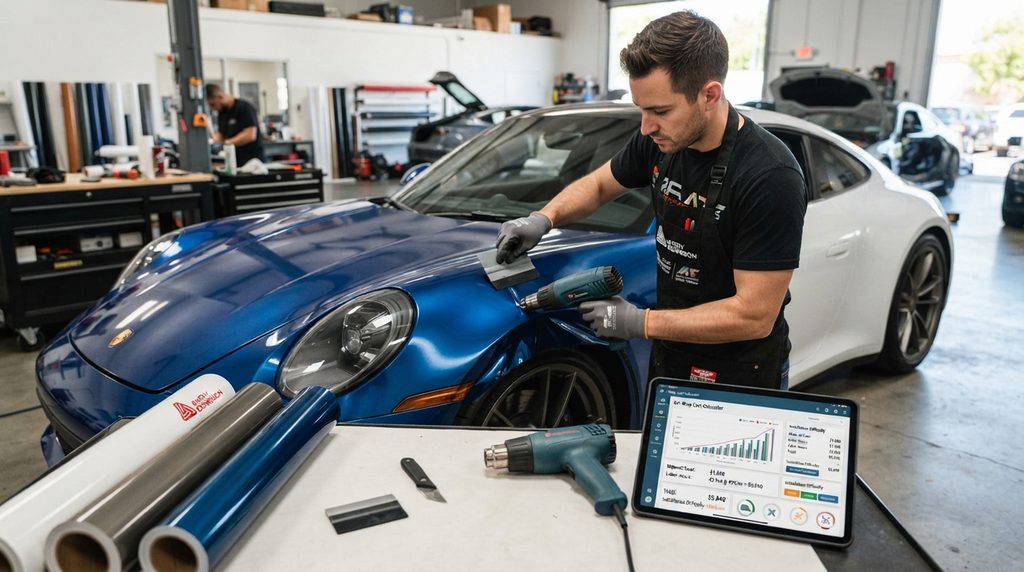
A car wrap cost calculator can’t replace a shop quote, but it can tell you if the number you’re hearing is in the right range. A car wrap quote can range from $1,500 to $12,000 for what looks like the same basic service, and that gap isn’t a scam: it’s the direct result of three variables stacking on top of each other: vehicle size, vinyl quality, and how much of the car you’re actually covering. This calculator breaks down that math so you can see where your estimate is likely to land before you ever talk to a shop.
Car Wrap Cost Calculator
Enter your vehicle size, vinyl quality, and coverage to see a realistic cost breakdown.

DATA INTELLIGENCE UNIT
Finanlytic Tool
Car Wrap Cost Calculator
Estimate your wrap cost using the same material + labor math shops actually use.
Run your own numbers above, then read on for what actually drives that huge price range, and why the cheapest quote isn’t always the smart choice.
The Car Wrap Cost Calculator Formula: Surface Area × Material + Labor
Every wrap quote comes down to the same underlying math, even when shops present it as a flat number. Vehicle size determines total square footage — a compact sedan needs roughly 55-65 sq ft of vinyl, an SUV around 75-90 sq ft, and a truck or van 100+ sq ft. That square footage gets multiplied by the material cost per square foot, then added to the labor cost per square foot for installation. A bigger vehicle isn’t just “a bit more” — it directly multiplies both the material and labor cost at once, which is why trucks and vans consistently land at the top of every pricing chart.
Standard Vinyl vs. Specialty Finishes: Where the Price Really Jumps
This is the single biggest lever after vehicle size. Standard cast vinyl in a solid gloss or satin color typically runs the baseline rate. Specialty finishes — chrome, color-shift/color-flip films, or brushed metal textures — can cost nearly double per square foot, and that’s before accounting for the extra installation time these finishes demand. Chrome in particular is widely considered the most difficult film to install: seams are highly visible, the material doesn’t forgive mistakes, and some shops decline chrome jobs entirely on vehicles with imperfect paint. If a quote for a “premium” wrap comes in surprisingly close to a standard one, it’s worth asking exactly which film is being used.
Full Wrap vs. Partial Wrap: The Coverage Decision
A full wrap covers every painted panel — bumper to bumper, complete color change or complete branding coverage. A partial wrap targets specific panels: the hood, roof, mirrors, or an accent stripe, and typically covers 40-60% of the vehicle’s surface. Partial wraps cost meaningfully less in raw material, but the savings aren’t perfectly proportional to coverage — a shop still has to set up, prep the vehicle, and dial in color matching regardless of how much surface they’re covering, so a 50%-coverage partial wrap often costs more than exactly half of a full wrap.
The Line Item Almost Every Estimate Skips: Panel Removal
Quotes built purely from a square-footage calculator tend to undercount one real cost: prepping the vehicle for a clean install. Removing door handles, mirrors, badges, and trim pieces before wrapping — rather than cutting the vinyl around them — adds real labor hours, but it’s also what separates a wrap that looks factory-installed from one with visible seams that lift within months. This panel-removal and prep work is a legitimate line item, not an upsell, and skipping it to save money is one of the most common ways a wrap ends up looking worse and lasting less than it should.
Why Cast Vinyl Costs More Than Calendered, And Why It’s Usually Worth It
Vinyl film splits into two manufacturing types, and the difference matters more than most first-time buyers realize. Cast vinyl is manufactured thin and with minimal internal tension, which lets it conform smoothly around curves, mirrors, and bumpers without shrinking or lifting — it’s rated for roughly 5-7 years of use. Calendered vinyl costs less upfront but is stiffer, performs poorly on complex body lines, and tends to fail sooner, often within 2-3 years. A wrap quoted well below the standard range is frequently a signal that calendered vinyl is being used — not necessarily a bad choice for a short-term or budget job, but worth knowing explicitly rather than discovering it when the edges start lifting.
Finanlytic Takeaway
FINANLYTIC | DATA INTELLIGENCE UNIT | Analysis by Hugo | Lead Market Strategist
A car wrap cost calculator earns its value by showing the real formula: square footage × material rate, plus labor, plus the panel-removal work that a lot of quotes leave out entirely. Vehicle size sets the floor, but vinyl quality and coverage decision do the rest of the work in determining where a specific quote lands, and a price that looks unusually low is worth double-checking on film type before assuming it’s simply a better deal.