
Financial Disclaimer: The strategic analysis from the Finanlytic Data Intelligence Unit is meant for informational and educational purposes only. Content created by Hugo Cutillas or other contributors shouldn’t be taken as professional financial, tax, or legal advice. Finanlytic is not a registered financial advisor or tax professional. Always do your own research and consult with a certified financial professional before making decisions based on your specific salary or compensation situation.
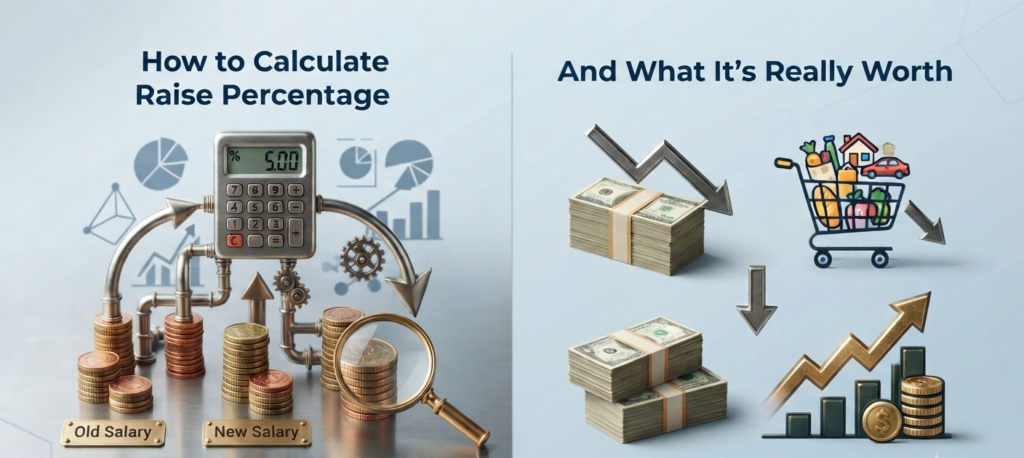
A job offer letter shows a new number, not a percentage — and most people do the math in their head, badly, in about ten seconds. Knowing how to calculate raise percentage correctly, in both directions, takes the same amount of time and tells you something your gut math usually misses: whether that raise actually beat inflation, or just felt good for a moment before your buying power quietly went nowhere.
Raise Percentage Calculator

DATA INTELLIGENCE UNIT
Calculate your raise percentage from two salary figures, or find your new salary from a given percentage — both directions, with the real inflation-adjusted number included.
Finanlytic Tool
Raise Percentage Calculator
Calculate your raise percentage, or your new salary from a given percentage — both directions.
Run your own numbers above, then read on for the formula behind it, real 2026 benchmarks, and a few details that most raise calculators skip entirely.
The Formula, In Both Directions
Calculating how to calculate raise percentage from two salary figures uses one formula: raise% = (new salary − old salary) ÷ old salary × 100. A salary moving from $58,000 to $61,480 works out to ($61,480 − $58,000) ÷ $58,000 × 100 = 6%.
Going the other direction — finding your new salary from a known percentage — flips the formula around: new salary = current salary × (1 + raise% ÷ 100). A 5% raise on $60,000 becomes $60,000 × 1.05 = $63,000. Both directions come up constantly: the first when comparing a current offer to a new one, the second when negotiating and trying to see what a specific percentage would actually mean in dollars.
What Counts as a Good Raise in 2026
Context matters more than the raw percentage. According to PayScale’s 2026 Salary Budget Survey, the median U.S. employer raise budget sits at 3.5%, while the Bureau of Labor Statistics’ Employment Cost Index put wage growth at 3.9% year-over-year in Q1 2026. A reasonable framework for 2026: 3–3.5% for meeting expectations, 4–6% for exceeding them, and 7% or higher typically reserved for promotions or high-demand roles being actively retained.
That 7%+ tier compounds meaningfully over time — at 7% annually, a salary roughly doubles in about 10 years, a pace usually reserved for people an employer considers genuinely difficult to replace.
The Number That Actually Matters: Real vs. Nominal
This is the calculation most raise conversations skip entirely, and it’s the one that determines whether a raise is actually a raise. With 2026 inflation running at approximately 2.8% (CPI-U), any raise below that threshold represents a real decline in purchasing power — your salary number went up, but what it can actually buy went down.
A 3% raise against 2.8% inflation leaves just 0.2% in genuine gain. On a $65,000 salary, that’s a real increase of roughly $130 a year — a rounding error dressed up as good news. The gap gets more consequential at the median: a 3.5% raise (this year’s typical employer budget) against 2.8% inflation leaves 0.7% in real terms, around $455 a year on a $65,000 salary. It’s a real gain, but a modest one, and worth knowing before deciding how to react to an offer letter.
Don’t Forget: Raises Affect Overtime Too
A detail that surprises hourly workers specifically: overtime pay scales automatically with any raise to your base rate, since overtime is calculated as 1.5× (or 2× in some states) your regular hourly rate. A $1.00/hour raise on a $20.00/hour base doesn’t just add a dollar to your straight-time pay — it pushes your overtime rate from $30.00/hour to $31.50/hour as well. For anyone who regularly works overtime, this makes even a modest hourly raise worth slightly more than the headline number suggests.
What the Take-Home Number Actually Looks Like
Gross raise percentage and net take-home increase are two different numbers, because taxes apply to the portion of your raise that falls into your marginal tax bracket, not your full salary. At roughly a 25% effective tax rate, a $3,000 raise on $60,000 works out to about $188 more per month in take-home pay — noticeably less than the $250/month the raw math might suggest before considering withholding. Knowing what your paycheck actually clears after taxes turns a percentage on an offer letter into a number you can actually plan a budget around, rather than a figure that quietly shrinks once the first paycheck arrives.
Finanlytic Takeaway
FINANLYTIC | DATA INTELLIGENCE UNIT | Analysis by Hugo | Lead Market Strategist
How to calculate raise percentage isn’t complicated math — it’s a 10-second formula in either direction. What actually takes effort is checking that number against something real: 2026 inflation at roughly 2.8%, your specific tax bracket, and whether the raise even clears your employer’s typical budget for the year. A 6% raise and a 3% raise both sound like good news read off an offer letter. Only one of them is, once inflation and taxes have their say.