
Financial Disclaimer: The strategic analysis from the Finanlytic Data Intelligence Unit is meant for informational and educational purposes only. Content created by Hugo Cutillas or other contributors shouldn’t be taken as professional investment, financial, tax, or legal advice. Trading in fast-paced markets carries a significant risk of losing capital. Finanlytic is not a registered financial advisor or broker-dealer. We analyze complex data signals, but remember, just because something worked in the past doesn’t guarantee it will work in the future. Always do your own research and consult with a certified financial professional before making any market moves.
In the first quarter of 2026, the corporate contract officially falls apart. For years, there was an unspoken agreement: when productivity went up, so did value, which eventually meant better wages and more opportunities for career growth. But in 2026, that connection has been cut. At the Finanlytic Intelligence Unit, we’re keeping an eye on a trend we call Value-Based Synthesis. While AI has empowered individual professionals to produce the work of an entire department, the profits from this newfound efficiency are being hoarded at the corporate level.
You’re not just “busy”; you’re experiencing the Great Salary Stagnation firsthand, where a 300% boost in your efficiency leads to a flat 0% increase in your real wages.
Erasing the Rungs of the Ladder
The most shocking effect of AI by 2026 isn’t just the “mass replacement” of CEOs, it’s the complete disappearance of entry-level jobs. We’re calling this the Entry-Level Cliff. In the past, building a career often started with the “grunt work”, think data entry, basic analysis, drafting documents, and handling administrative tasks. These were the essential steps on the career ladder. Nowadays, specialized AI tools can perform these tasks with 99% accuracy in the blink of an eye.
The Structural Crisis: Without these foundational roles, young professionals are missing out on the essential experience they need to eventually become senior decision-makers.
The Result: The middle-class career path is being eroded. If you’re a mid-level professional today, you’re caught in a squeeze; automation is taking over the lower-level tasks, while the leadership above you expects you to manage the output of the machines you once trained.
The Wage Compression Trap

In 2026, one “Super-Employee” can now handle a workload that used to require a team of three. From a management standpoint, this is a remarkable feat of Operational Efficiency. But from your viewpoint, it feels like a Leverage Killer. When a task becomes “easy” thanks to AI, the market value of that task plummets to almost nothing. Even if you’re the one guiding the AI to produce top-notch work, your boss realizes that your labor is no longer scarce. This results in Wage Compression:
The Burden: You end up taking on the roles of the three people who were either laid off or never brought on board.
The Pay: You receive a “cost-of-living” raise (typically around 3-4%) that barely keeps up with the Energy Transition Friction we talked about in our last discussion.
The Outcome: You’re more productive than ever, yet your actual purchasing power is slipping away. It feels like you’re running a marathon just to stay in the same spot.
DATA INTELLIGENCE UNIT
| Metric | 2020 Baseline | 2026 Reality | Finanlytic Impact |
| Output per Worker | 1.0x | 3.5x | Massive corporate margin expansion. |
| Real Wage Growth | +2.1% | -0.5% (Adj. for inflation) | Total decoupling of pay from productivity. |
| Bargaining Power | High (Labor Shortage) | Low (AI Commodity) | Skills are being commoditized at scale. |
| Career Path | Linear / Vertical | Fractured / Horizontal | The “Promotion” is being replaced by “Expansion.” |
Why Context is the Only Asset Left
If you find yourself juggling the workload of three people, chances are you’re spending a whopping 80% of your day just “managing machine output.” By 2026, execution will be a dime a dozen. The one thing that will still hold value? Contextual Judgment.
We like to call the Human Moat those unique skills that machines simply can’t mimic because they don’t have “Skin in the Game.” Take High-Context Negotiation, for instance: Sure, AI can whip up a contract, but it can’t sense the atmosphere during a tense negotiation.
Then there’s Ethical Accountability: A machine can crunch the numbers on risk, but it can’t shoulder the blame. In 2026, companies will be willing to pay for a “Human to Blame” when things go south due to machine decisions.
And let’s not forget about Ambiguous Decision-Making: In those unpredictable “Black Swan” moments where data is scarce, the human gut instinct remains the most valuable asset in the economy.
To understand where your specific industry stands in the 2026 automation curve, we recommend reviewing the OECD Employment Outlook on AI. Cross-referencing their data with our “Task Erosion” model confirms that the risk is not “losing a job,” but the Wage Compression that occurs when 40% of your daily tasks become commoditized.
Why Emotional Intelligence is the New Hard Skill
Despite the immense hype surrounding generative models, AI in 2026 continues to hit a cognitive wall when faced with high-context human interaction. This forms what we call the Human Moat, a collection of skills that remain resilient to automation. This moat consists of Emotional Intelligence—the ability to build trust, empathy, and resolve complex interpersonal conflicts—and Ethical Responsibility. While a machine can calculate a risk/reward ratio, it cannot take moral accountability for a decision. Furthermore, Ambiguous Decision-Making in the face of “black swan” events, where no historical data exists for the AI to reference, remains a purely human domain. Consequently, visionary leaders, healthcare professionals, and skilled negotiators are seeing their value appreciate in an increasingly automated world.
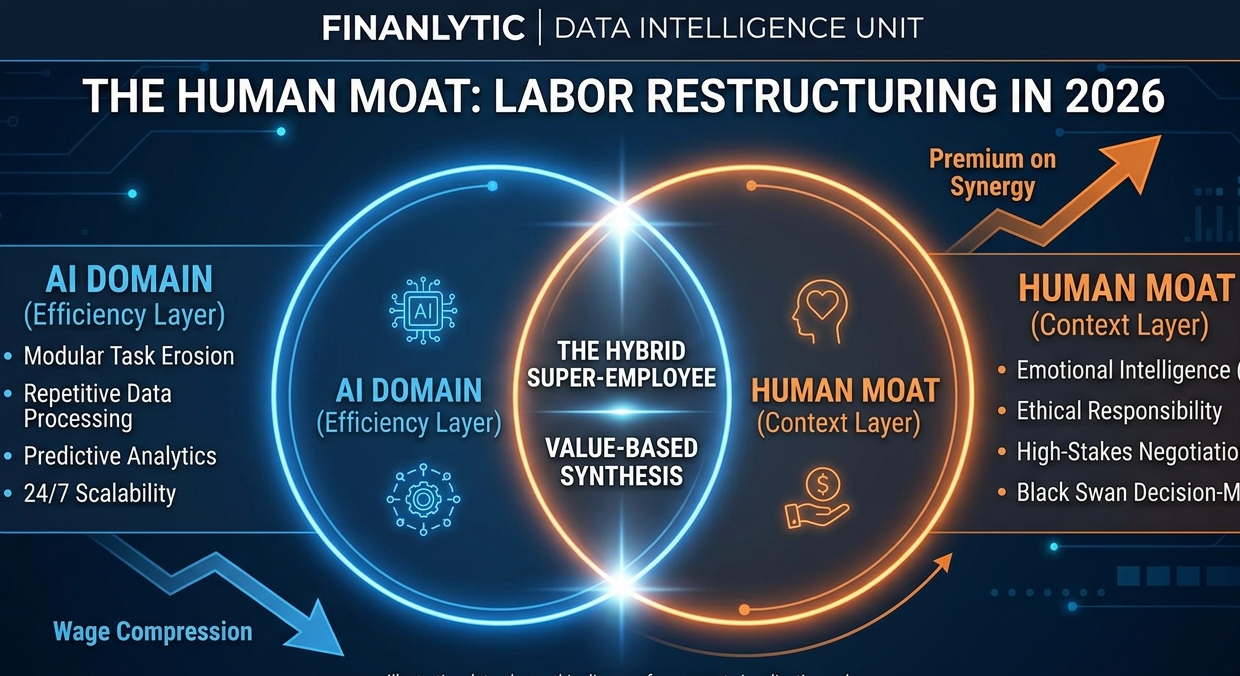
Finanlytic Diagram: Human Moat, AI vs Human Capabilities 2026.
The Psychological Toll
The economy in 2026 isn’t just taking a bite out of your paycheck; it’s gnawing away at your drive. When hard work stops providing a safety net, many professionals find themselves in Survival Mode. The pressure to “upskill or die” is relentless. This year, feeling irrelevant has become the new midlife crisis. To make matters worse, wealth is piling up in Hard Assets, like Stocks, AI Infrastructure, and Real Estate, at a speed that your labor income, no matter how hard you hustle, just can’t keep up with. It feels like labor is losing the race against capital.
Finanlytic Takeaway
FINANLYTIC | DATA INTELLIGENCE UNIT | Analysis by Hugo | Lead Market Strategist
The truth about 2026 is that the old mantra of “Working Harder” is just a trap set to drain your efforts for the benefit of the wealthy. If you find yourself doing the work of three people but only getting paid for one, you’re caught in the cycle of Lifestyle Inflation without any of the perks.
To thrive, you need to shift from being just a Task-Doer to becoming a Strategic Orchestrator.
Stop thinking of yourself as a Resource: Resources get depleted. Instead, think like an Architect who is brought in to create something lasting.
Monetize the Synthesis: Your true worth lies not in merely “doing” the tasks, but in your ability to blend ideas from different fields in ways that AI simply can’t replicate.
Prioritize Mobility over Loyalty: Use the time you save with AI to develop Side-Assets. If your company is reaping three times the value from your work, you should aim to reclaim three times that amount of time to establish your own independence.
In 2026, the “Standard Adjustment” means the system will take everything you don’t actively defend. It’s time to stop playing the numbers game and start focusing on Strategic Positioning.