

Financial Disclaimer: The strategic analysis from the Finanlytic Data Intelligence Unit is meant for informational and educational purposes only. Content created by Hugo Cutillas or other contributors shouldn’t be taken as professional investment, financial, tax, or legal advice. Trading in fast-paced markets carries a significant risk of losing capital. Finanlytic is not a registered financial advisor or broker-dealer. We analyze complex data signals, but remember, just because something worked in the past doesn’t guarantee it will work in the future. Always do your own research and consult with a certified financial professional before making any market moves.
More and more professionals are coming to the realization that getting a salary bump isn’t the hallmark of success it used to be; instead, it’s become a cleverly disguised distraction from the mounting economic pressures of 2026. For years, a “raise” was the shining beacon for the middle class, the clear evidence of progress. The reasoning was straightforward: if you ascended the career ladder, the other pieces of life, like stable housing, quality education, and a comfortable retirement, would fall into place. But as we navigate through 2026, that social contract has been completely upended. We’ve now stepped into what I like to call the Age of the Salary Increase Illusion.
It’s a reality where earning more means you have to run faster to stay in the same spot. Even though the numbers on our paychecks are higher than ever, the actual sense of wealth feels like it’s vanished. We’re witnessing what I’d call the Hidden Theft of the professional class.
The Anatomy of the Illusion: When “More” Means “Less”

On the surface, the modern professional seems like a shining success story. Their resumes boast steady promotions, and their annual income would have been considered “wealthy” just fifteen years ago. However, beneath this facade lies a reality filled with Quiet Pressure. The main issue? The slow but steady erosion of Purchasing Power. A salary isn’t just a fixed prize; it’s a flexible tool designed to help us buy the essentials we need. But when the prices of those essentials rise faster than our paychecks can keep up, that tool starts to lose its edge. In 2026, a 5% raise might be celebrated in the office, but at the same time, a 7% jump in the Permanent High-Cost Baseline (think groceries, energy, and services) is happening quietly in the background. This isn’t just inflation; it’s a fundamental devaluation of our labor.
To better understand the concept of “New Economic Friction,” let’s take a closer look at the data concerning high-income households. This investigation by CNBC dives into the underlying systemic issues that are causing even those with six-figure salaries to find it tough to create a financial cushion in the current economic landscape of 2026.
The Rent-Seeker Economy
A decade ago, a significant pay raise led to a noticeable boost in “disposable income”—the kind of cash that could help you build your own wealth. Fast forward to 2026, and that same raise gets quickly consumed by what we call a Rent-Seeker Economy. Everything has changed, from the essential software you need for work to the basic entertainment you enjoy at home. We’ve moved away from owning things outright to a model where you’re hit with monthly fees. These little financial leaks might seem insignificant on their own, but together, they drain a “good salary” from multiple angles. You’re not just buying products anymore; you’re essentially paying a “subscription to exist” in a fast-paced society.
To shed light on this issue, the Finanlytic Intelligence Unit digs into the deeper reasons why even six-figure salaries are finding it tough to create a financial cushion in today’s world. This isn’t about individual shortcomings; it’s a systemic issue where the value of work doesn’t match the cost of living.

DATA INTELLIGENCE UNIT
| Factor | Legacy Expectation | 2026 Reality (The Illusion) |
| Annual Raise | 3-5% (Net Gain) | 5% (Net Loss against real CPI) |
| Housing Cost | 25% of Income | 45-55% of Net Income |
| Career Maintenance | Company Funded | “Reskilling Tax” (Out-of-pocket) |
| Lifestyle Model | Ownership | Perpetual Subscription (Leasing) |
The Anchor That Sinks the Professional Ship
No single factor has skewed our perception of salary value quite like the cost of housing. Whether someone is renting in a bustling city or paying off a mortgage, the burden of shelter has become a heavy anchor. By 2026, what we consider a “good salary” is now just the bare minimum needed to allocate half of your take-home pay to a modest apartment. When such a significant chunk of your earnings goes straight to a landlord or a bank, it really limits your ability to take career risks or invest in new opportunities. With interest rates staying stubbornly high, the Borrowing Barrier feels like a lid on wealth creation, keeping the “salary class” forever separated from the “asset class.”
The data visualization we’re looking at really brings to light the essence of the “New Economic Friction.” By comparing median wage growth with the rising costs of essential goods and services, we can pinpoint exactly where middle-class professionals are struggling. This isn’t about individual shortcomings; it’s a clear sign of a systemic gap between the value of work and the cost of living in 2026.
https://www.visualcapitalist.com/median-house-prices-vs-income-us
The Invisible Career Maintenance
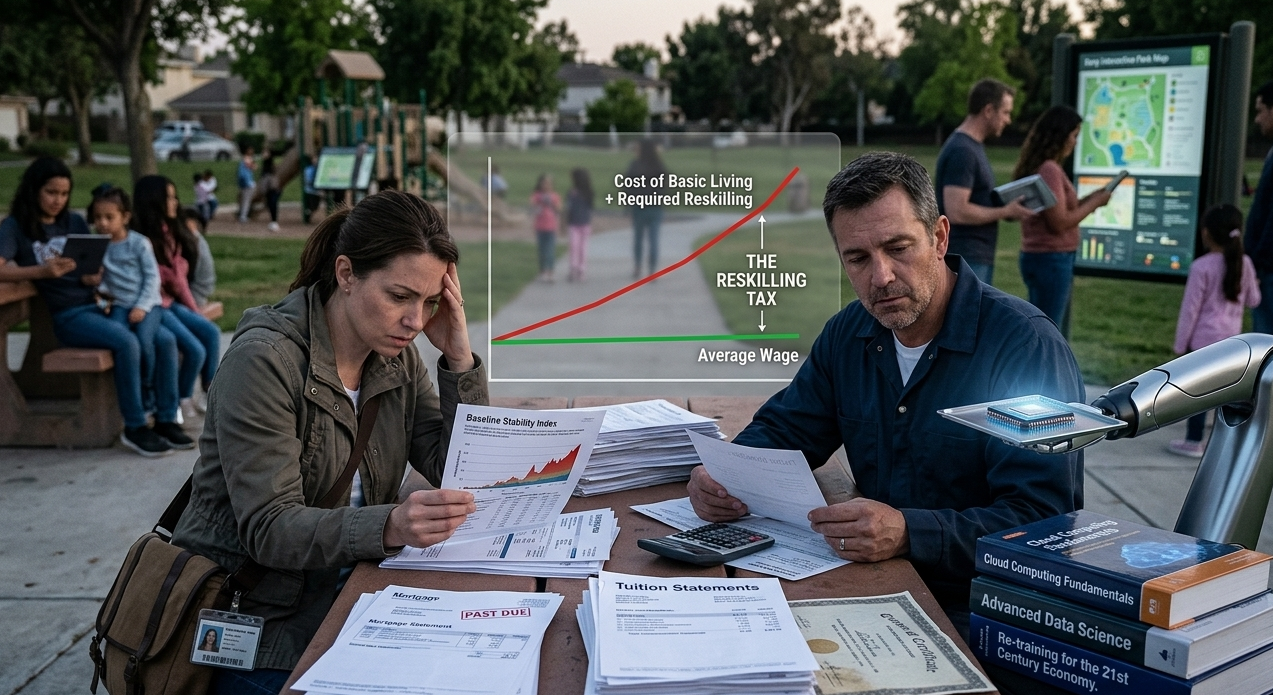
Beyond just food and shelter, the cost of being a “functional member of society” has shot up dramatically. In the 2026 AI-driven economy, simply doing your job well isn’t enough to guarantee stability anymore; it’s something you have to pay for yourself. We’ve dubbed this the Reskilling Tax. To keep your salary high, you need to continually invest in private education, certifications, and top-notch hardware. This “career maintenance” is an expense that previous generations didn’t have to worry about.
For families with two incomes, these costs, along with soaring childcare and healthcare expenses, make climbing the professional ladder feel like a zero-sum game. What some critics refer to as “lifestyle inflation” is really just Standard Adjustment—the price tag for staying relevant.
Labor is Losing to Capital
The harsh reality of 2026 is that Labor is losing ground to Capital in a big way. There’s a huge gap in how quickly wealth is being generated. Things like stocks, real estate, Bitcoin, and AI infrastructure are racking up value at a pace that leaves even the biggest salary hikes in the dust. While there’s a limit to how much money you can make in an hour, there’s practically no ceiling on how much an asset can grow in value. If your only game plan is to “work harder for a better salary,” you’re essentially playing a rigged game. The Salary Increase Illusion keeps you fixated on the “gross number,” while the system quietly robs you of your “net time.”
Before jumping to the conclusion that you need a higher salary, take a moment to examine these three potential leaks in your current cash flow:
- Subscription Bloat: Look for those sneaky recurring expenses that have shifted from one-time buys to ongoing monthly drains.
- Asset-to-Liability Ratio: Are you living a high-performance lifestyle solely through your paycheck, or are you smartly turning your income into assets with some speed?
- The Reskilling Tax: Don’t forget to account for the 2-5% of your income you’ll need to invest each year to keep your skills sharp in this fast-paced, AI-driven job market.
Finanlytic Takeaway

FINANLYTIC | DATA INTELLIGENCE UNIT | Analysis by Hugo | Lead Market Strategist
The high-income professional of 2026 finds themselves at a pivotal moment. Getting a raise and feeling “wealthier” can actually be a deceptive trap. To truly liberate yourself from that feeling of being overwhelmed, it’s essential to shift your focus away from just your paycheck and start thinking about Asset Velocity. In today’s world, real wealth isn’t just about how much you earn; it’s about what you own that continues to grow even while you sleep. At Finanlytic, we’re convinced that mastering this transition from earning a salary to building capital is the key to transforming a “good salary” back into what it was always intended to be: a means to achieve true freedom. The raise can be a distraction; it’s the assets that provide the real escape.