
Financial Disclaimer: The strategic analysis from the Finanlytic Data Intelligence Unit is meant for informational and educational purposes only. Content created by Hugo Cutillas or other contributors shouldn’t be taken as professional investment, financial, tax, or legal advice. Trading in fast-paced markets carries a significant risk of losing capital. Finanlytic is not a registered financial advisor or broker-dealer. We analyze complex data signals, but remember, just because something worked in the past doesn’t guarantee it will work in the future. Always do your own research and consult with a certified financial professional before making any market moves.
Markets don’t just suddenly “break” out of the blue. They don’t wake up one day and decide to panic. When you witness a sudden crash, what you’re really seeing is the final snap of a structure that’s been weakening for weeks. Retail investors often miss the warning signs because they’re focused on the wrong things: price movements and headlines. By the time the news comes out explaining why the market is dropping, the big move has already happened.
To navigate 2026 successfully, you need to pay attention to the underlying geometry of the price. You have to notice the subtle signals, the shifts in liquidity, and the breakdown of correlations, before the storm makes it to the front page.
The Signature of a Nervous Market
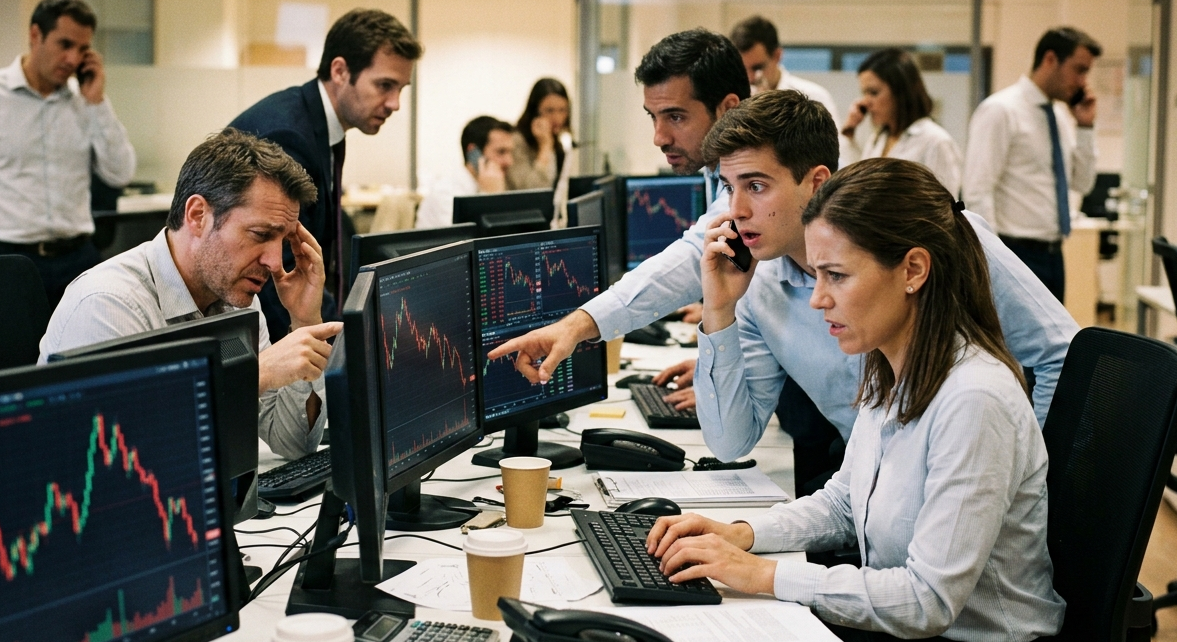
Market anxiety tends to creep in quietly before it makes a big noise. It doesn’t kick off with a dramatic sell-off; instead, it begins with those pesky “technical glitches” and some strange movements in safe havens. You might notice Treasury bonds or Gold acting in ways that just don’t align with the current economic story. Liquidity starts to dwindle in certain areas. Not everywhere, but in those specific, high-value spots. This is the first hint that institutions are pulling back. The big players don’t rush for the exits; they take a step back and observe. This creates a situation where the market loses its “cushion.” When the depth of the market thins out, even a small sell order can send prices tumbling much further than expected.
At Finanlytic, we keep a close eye on the structural integrity of the Order Book. When we see the bid-ask spreads widening, even in assets that are usually very liquid, it signals a shift in the market’s dynamics. Essentially, the market is starting to feel a bit “brittle.”
Volatility is Uncertainty, Not Just Fear
A lot of folks tend to view volatility as just a source of fear, but in the world of finance, it’s really more about uncertainty. When you see the VIX or similar indicators on the rise, it’s a sign that investors are scrambling to grasp risks that aren’t entirely clear yet. The options market can be a goldmine of information for those who know how to dig into it. Take skew, for instance, which highlights the cost differences between put and call options, or the shifts in open interest; these often change days before a major price movement occurs. Seasoned investors tend to act before a downturn is officially acknowledged. They keep a close eye on implied volatility to safeguard their investments ahead of the crowd, ensuring they’re protected before panic sets in. When volatility starts to shift independently of price changes, it’s a clear signal that savvy investors are bracing for something significant. This distinction is one of the most reliable indicators that a shift in market leadership is on the horizon.
The Selective Nature of Liquidity
One of the most telling signs of a jittery market is how liquidity behaves, though it might not be immediately obvious. In stable times, liquidity is almost like a ghost, hardly noticeable. You can make big trades without a second thought, spreads remain tight, and everything flows smoothly. But as soon as uncertainty starts to creep in, things shift dramatically. Liquidity doesn’t just vanish; it becomes choosy. You can spot it in the finer details: bid-ask spreads widen, even for assets that are typically very liquid. Trades start to slip more than you’d expect, and prices can jump around on surprisingly low volume. It just feels off. This isn’t just a random fluctuation; it’s a sign of caution.
Big players aren’t making a mad dash for the exits; instead, they’re pulling back and biding their time. When that happens, the market loses its buffer. The depth thins out, and suddenly, even small orders can send prices soaring or plummeting much more than they should. To grasp why markets become so hyper-reactive, you need to understand how institutional liquidity cycles function during times of high-gamma exposure. When market makers find themselves in a “Negative Gamma” situation, they have to sell into a declining market to balance their positions, creating a scenario where prices can plummet by 5% in just a few minutes.
At Finanlytic, we go beyond just keeping an eye on prices; we also assess the structural integrity of the order book. To truly grasp why markets can become so hyper-reactive, it’s essential to delve into how institutional liquidity cycles function during times of high-gamma exposure. This analysis will break down the mechanics behind these subtle shifts, offering a visual confirmation of the signals we’ve talked about concerning institutional withdrawal and the widening of bid-ask spreads.
When Correlations Start to Crack
Another subtle warning sign appears when the familiar relationships between assets begin to unravel. Typically, markets move in recognizable patterns: stocks and bonds tend to react in harmony, currencies follow commodities like oil, and correlations feel almost predictable. It creates a certain rhythm. However, when pressure mounts, that rhythm starts to fade. Assets that usually move in tandem begin to drift apart. Correlations weaken or even reverse. When this occurs, it’s not merely a technical shift; it’s a clear indication that the market is losing its consensus on the broader picture. There’s no cohesive narrative tying everything together. In that void, volatility often takes charge, as the system aggressively seeks a new equilibrium.
Cross-Market Signals and the Crypto Gauge
In our fast-paced, interconnected markets, stress tends to spill over, and crypto often feels the brunt of it first. Since it operates around the clock, crypto has quietly evolved into a real-time gauge for global liquidity and risk appetite. It responds instantly, without waiting for traditional market hours, making it one of the first places where shifts in sentiment become evident. You might notice this happening over the weekend. If crypto starts to show increased volatility while liquidity is tightening, it’s usually not just a standalone event. More often than not, it serves as an early indicator of how traditional markets might react when they open on Monday.
By the time the S&P 500 or Nasdaq begins trading, they’re typically playing catch-up to a move that crypto has already begun to price in a couple of days earlier.
The Hidden Danger of Overcrowded Positioning

Positioning is one of those signals that many retail investors tend to overlook, but professionals keep a close eye on it. Markets can get shaky when too many participants are all leaning in the same direction. When a trade becomes “crowded,” it loses its resilience. Just a small shift can cause everything to unravel quickly. You can spot this buildup in areas like fund flows, derivatives funding rates, or futures positioning. They might not always scream danger, but they definitely give off hints. When everyone is on the same side of the trade, the real risk isn’t just being wrong; it’s how quickly things can shift when the exit gets crowded.
Why the Headlines Are Always Late
By the time fear hits the front page, the wheels are already in motion. That’s why reactive investors often find themselves lagging; they’re busy chasing explanations instead of paying attention to the signals. They wait for headlines to confirm what’s happening, while the market has already adjusted to the change. Markets don’t react to what is; they respond to what could be. It’s all about probabilities, expectations, and positioning. Meanwhile, news reports on what has already taken place. That gap is where most people end up falling short.
How AI Processes the Noise of the Market
Artificial intelligence has fundamentally transformed one key aspect: speed. Today’s systems don’t pause to ponder why things are happening. They’re not concerned with stories or political implications. Instead, they focus on what can be measured: shifts in volatility, deviations from the norm, and changes in correlations. On a micro level, these systems analyze the market in ways that humans simply can’t, processing order book changes and flow imbalances in real time. In a jittery market, speed and objectivity take precedence over everything else. By the time a person has absorbed the news and formed an opinion, the market has already begun to move.
Finanlytic Takeaway

FINANLYTIC | DATA INTELLIGENCE UNIT | Analysis by Hugo | Lead Market Strategist
The most perilous moment in any market isn’t when fear peaks; it’s that unsettling quiet that comes just before it. That’s when people tend to feel too comfortable. On the surface, everything seems fine, but beneath it all, warning signs are beginning to emerge.
Liquidity is changing, positions are getting stretched, and correlations are starting to drift, yet the official story hasn’t caught up with reality. Markets don’t collapse in straightforward conditions. They unravel when things are out of sync beneath the surface. If you’re looking to safeguard your capital or spot opportunities in 2026, the trick is to tune into those early signals, the subtle hints. If you ignore them, the market will eventually demand your attention, often at the most inconvenient time.
At Finanlytic, we’re here to help you catch those shifts while they’re still just whispers, not when they’ve already escalated into chaos.