
Financial Disclaimer: The strategic analysis from the Finanlytic Data Intelligence Unit is meant for informational and educational purposes only. Content created by Hugo Cutillas or other contributors shouldn’t be taken as professional investment, financial, tax, or legal advice. Trading in fast-paced markets carries a significant risk of losing capital. Finanlytic is not a registered financial advisor or broker-dealer. We analyze complex data signals, but remember, just because something worked in the past doesn’t guarantee it will work in the future. Always do your own research and consult with a certified financial professional before making any market moves.
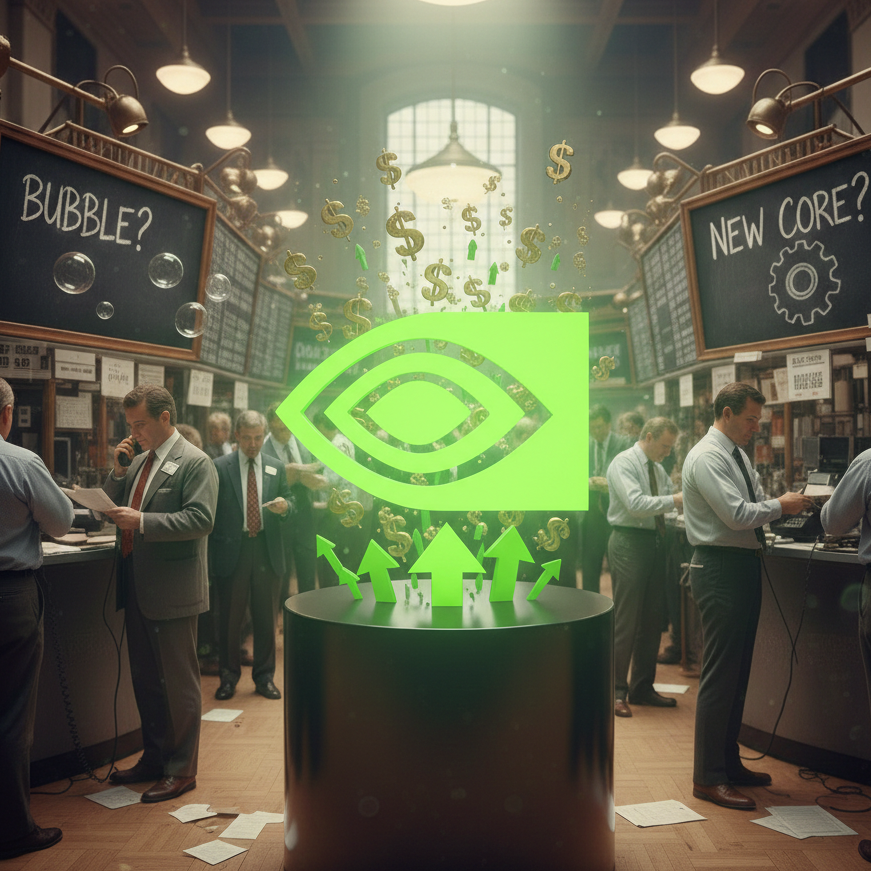
The financial headlines of 2026 are buzzing with one name: Nvidia. But this isn’t just a tale for stock traders or those in Silicon Valley. If you’ve got an index fund, a 401(k), or a pension plan, chances are you’re an Nvidia investor, even if you don’t realize it. With its valuation hitting historic highs, the global investment community is divided: are we witnessing a repeat of the 2000 dot-com bubble, or have we truly transformed the engine of the global economy?
The real question goes beyond short-term price fluctuations. It’s about grasping the systemic connection that now ties your personal savings to the performance of a single company’s silicon production.
The Infrastructure Monopoly: The “Oxygen” of 2026
NVIDIA’s ascent marks a significant change in the landscape of global computing. We’ve transitioned from the age of general processing to one dominated by Massive Parallelism. At the heart of this shift is the GPU (Graphics Processing Unit). In the past, we relied on CPUs for tasks that needed to be done one after the other, but the AI revolution demands that we process billions of data points all at once. NVIDIA hasn’t just created a superior chip; they’ve established the essential “toll bridge” for the entire digital economy. By 2026, Nvidia is set to be the “arms dealer” of the AI age. No matter if a business is in healthcare, defense, or finance, staying competitive means they’ll have to pay the “Nvidia tax” to tap into the computing power they need. As long as the thirst for intelligence continues to grow, Nvidia will remain a crucial part of the global value chain’s infrastructure.
At Finanlytic, we dive deeper than just the ticker symbol; we explore the physical infrastructure that underpins it all. To truly grasp Nvidia’s leading position, it’s essential to recognize why parallel processing is considered the ‘lifeblood’ of the AI age. The following breakdown highlights the powerful synergy between hardware and software that has positioned Nvidia as the go-to partner for every major hyperscaler in 2026.

DATA INTELLIGENCE UNIT
| Factor | The Bull Case (Growth) | The Bear Case (Risk) |
| Revenue | Record-breaking Data Center sales. | Priced for “perfection” (No room for error). |
| Moat | Unrivaled CUDA software & GPU tech. | Rising competition from AMD & Custom Silicon. |
| Market Flow | Forced ETF buying (Passive support). | Extreme concentration / Systemic dependency. |
| Valuation | High, but backed by massive cash flow. | P/E multiples assume exponential growth. |
The Passive Investing Feedback Loop: Why You Are “In”
This is the part that really impacts your daily savings. Most modern retirement funds rely on Market-Cap Weighted Indices, like the S&P 500 or Nasdaq 100. This sets off a mechanical feedback loop: as Nvidia’s value climbs, index funds have to buy more shares to keep their balance. This creates a self-reinforcing cycle. When prices go up, it triggers more inflows into ETFs, leading to even more buying pressure, no matter what the actual valuation is. For the average saver, this means your so-called “diversified” portfolio is becoming more and more concentrated. NVIDIA has turned into a major player; when it shifts, the whole market, and your retirement balance, shifts along with it. We’re seeing a level of concentration that brings a new kind of risk: the “Single Point of Failure” for the financial system in 2026.
Bubble Signals vs. Fundamental Reality

It’s completely understandable to feel a bit anxious about a stock that’s skyrocketing so fast. Traditional metrics can seem a bit stretched, and you can definitely sense the “Fear of Missing Out” (FOMO) buzzing around in retail markets. But the landscape in 2026 is not the same as it was back in 2000. Unlike the dot-com boom, where companies were often valued based on mere “clicks” and “eyeballs,” Nvidia’s impressive growth is grounded in solid revenue and substantial free cash flow. They’re not just peddling a promise; they’re offering the most valuable physical commodity of the 21st century: computing power. The real risk isn’t that the technology isn’t real, it’s that the market might have already factored in a decade’s worth of flawless execution.
The “Pricing for Perfection” Risk
At its current valuation, Nvidia seems to be banking on the idea that the demand for AI hardware will keep skyrocketing indefinitely, and that rivals like AMD or custom chips from major tech companies won’t chip away at their impressive 80%+ profit margins. History tells us that even the most successful companies don’t always follow a straight path. Market leaders often experience downturns of 30% to 50% as they grow. In a high-stakes environment like 2026, even a slight miss in guidance can lead to wild fluctuations. Since a significant portion of the market’s overall gains is tied up in Nvidia, a “correction” here isn’t just a tech issue; it’s something that could impact retirement funds, too.
Strategic Lessons for the Modern Owner
Navigating today’s landscape means shifting from being a passive observer of market trends to becoming an active guardian of your investments.
Spot Hidden Concentration: Take a close look at your ETFs. It’s crucial to know just how much of your supposedly “diversified” fund is actually linked to Nvidia and the Big Tech giants.
Distinguish Hype from Reality: Pay attention to the real Data Center revenue and capital expenditures (CapEx) from hyperscalers. These figures are the true indicators, not just the flashy headlines.
The Ownership Shift: A strong portfolio in 2026 isn’t merely about holding shares in the chipmakers; it’s about investing in the companies that leverage this technology to boost their margins and cut down on labor costs.
Finanlytic Takeaway
FINANLYTIC | DATA INTELLIGENCE UNIT | Analysis by Hugo | Lead Market Strategist
NVIDIA is the “Railroad of the 21st Century.” But history’s lesson is cold: while railroads helped shape the modern world, the speculative frenzy around them wiped out the investments of those who jumped in at the peak. By 2026, your retirement savings might be linked to Nvidia, not necessarily by your own choice, but because of how the current financial system is set up. It stands as a critical point of failure in a market that’s become overly concentrated. To safeguard your purchasing power, you need to clearly differentiate between the groundbreaking potential of AI and the unpredictable “momentum trade” of its stock. In this new landscape, grasping that relationship isn’t just a valuable insight; it’s your best line of defense.
Understanding the difference between the underlying technology and the short-term “trade” around it is essential for navigating this environment.