
Financial Disclaimer: The strategic analysis from the Finanlytic Data Intelligence Unit is meant for informational and educational purposes only. Content created by Hugo Cutillas or other contributors shouldn’t be taken as professional financial, insurance, or remediation advice. Finanlytic is not a mold remediation contractor, insurance provider, or industry authority. Actual costs vary significantly by region, contractor, and project scope. Always get a quote from a licensed remediation specialist and review your specific insurance policy before making decisions about mold treatment.
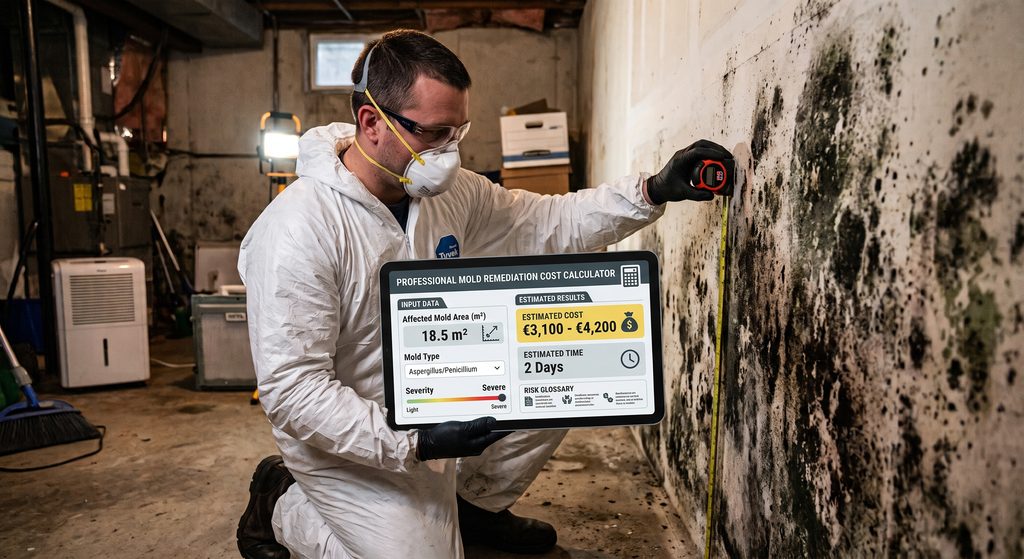
A mold remediation cost calculator can’t replace an inspection, but it can tell you if the quote you’re about to get sounds reasonable. Finding mold in a home raises one immediate question, and it’s rarely answered clearly until a contractor is already standing in the room: how much is this actually going to cost. The pricing follows a fairly consistent national formula, and knowing it before that first inspection call can be the difference between a fair quote and an inflated one.
Mold Remediation Cost Calculator

DATA INTELLIGENCE UNIT
Enter your affected square footage, access difficulty, and mold type to see a realistic cost estimate.
Finanlytic Tool
Mold Remediation Cost Calculator
Estimate your cost using the same per-square-foot math contractors use nationally.
Run your own numbers above, then read on for what actually drives the price per square foot, and why your insurance policy might leave you covering the full bill.
The Mold Remediation Cost Calculator Formula: Square Footage × Rate
Mold remediation cost calculator estimates all follow the same underlying structure: a base rate per square foot of contaminated surface, adjusted by two factors that can shift the final number considerably. The national standard rate in 2026 runs $10 to $25 per square foot for standard, accessible work — open walls, ceilings, or exposed surfaces a technician can reach without demolition. Most homeowners end up paying between $1,200 and $3,750 total, with a national average landing around $2,300 to $2,400, though whole-house situations after major water intrusion can reach $10,000 to $30,000.
Modifier One: Where the Mold Is Hiding
Accessible mold on an open wall or ceiling sits at the base rate. Mold requiring wall-cavity access, attic penetration, or crawlspace entry jumps to $15-$30 per square foot — sometimes 25-40% higher than the standard rate for the identical square footage. This isn’t an arbitrary upcharge: reaching hidden mold means removing drywall, insulation, or flooring first just to expose the contaminated material, which is real additional labor before the actual remediation work even begins. Two basements with visually identical mold coverage can end up with meaningfully different bills purely based on whether that mold sits on exposed concrete or behind a finished wall.
Modifier Two: What Kind of Mold You’re Actually Dealing With
Common household molds — Cladosporium, Penicillium, Aspergillus — remediate at the standard rate using standard personal protective equipment and EPA-registered antimicrobials. Black mold (Stachybotrys chartarum) is a different case entirely: contractors typically add a 15-25% premium on top of whichever base rate applies, because it requires full-face respirators, higher-grade HEPA filtration, and sealed waste handling under industry containment protocols. The premium reflects genuinely different safety requirements, not just a scarier name — black mold remediation work is procedurally more involved from start to finish.
The Line Items the Per-Square-Foot Rate Never Includes
This is the detail that most catches homeowners off guard when the final invoice doesn’t match their mental math. The per-square-foot remediation rate covers removal, containment, and treatment of the mold itself — it essentially never includes drywall replacement, painting, flooring, or structural repairs, which get billed as separate line items. New drywall installation typically runs $1,000-$2,900 for a standard bathroom or bedroom-sized project. Post-remediation clearance testing, which confirms the space is safe after treatment, adds another $300-$800 and is standard practice on any black mold job or any project over roughly $3,000. Add these together with the remediation itself, and a “simple” $2,000 mold job can realistically become a $3,500-$4,500 total project once reconstruction is factored in.
Why Your Homeowners Insurance Might Not Cover This At All
Most homeowners insurance policies only cover mold remediation when the mold resulted from a “covered peril” — something sudden and accidental, like a burst pipe or water damage from firefighting activities. Mold that developed from a slow, gradual leak, from chronic high humidity, or from delayed home maintenance is commonly excluded entirely, even though the mold itself looks identical to a covered case once it’s growing on the wall. This distinction — sudden accident versus gradual neglect — is the single detail that determines whether a homeowner pays out of pocket for the full amount above, or files a claim that actually gets approved. It’s worth reviewing a specific policy’s mold provisions before assuming coverage either way.
Finanlytic Takeaway
FINANLYTIC | DATA INTELLIGENCE UNIT | Analysis by Hugo | Lead Market Strategist
A mold remediation cost calculator earns its value by showing the real formula: square footage times a base rate, adjusted for access difficulty and mold type — not a flat number that ignores where the contamination is hiding or what species it actually is. The per-square-foot rate covers remediation only, so budgeting for drywall, painting, and clearance testing as separate costs prevents the most common source of invoice shock. And before assuming insurance will cover any of it, confirming whether the underlying cause counts as a “covered peril” under a specific policy is worth doing before the first contractor call, not after.