
Financial Disclaimer: The strategic analysis from the Finanlytic Data Intelligence Unit is meant for informational and educational purposes only. Content created by Hugo Cutillas or other contributors shouldn’t be taken as professional financial or credit advice. Finanlytic is not a registered financial advisor or credit counselor. BNPL terms, fees, and credit-reporting policies can change and vary by retailer and specific offer. Always review the exact terms shown at checkout and consult a certified financial professional before making decisions about your specific situation.
Choosing between Affirm vs Afterpay comes down to one real question: which one costs you less for the specific purchase you’re about to make. Both show up at checkout promising the same basic idea: split a purchase into smaller payments instead of paying all at once. But Affirm and Afterpay work on genuinely different models underneath that similar pitch, and the difference between them can mean paying zero extra, or paying real interest on top of what you already owed.
Affirm vs Afterpay: What Each One Actually Is
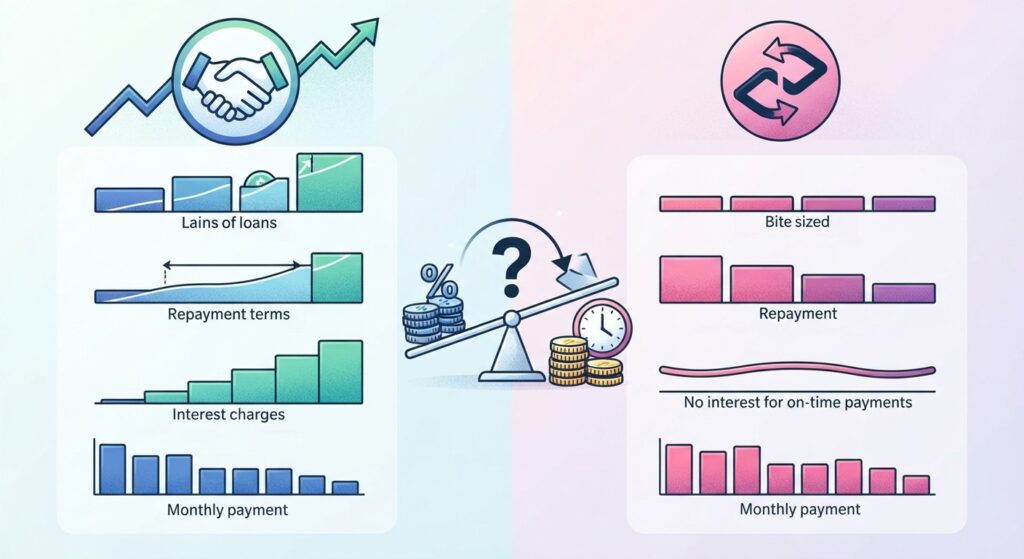
In the Affirm vs Afterpay comparison, Afterpay is built around a single core product: Pay in 4… splitting a purchase into four equal installments paid every two weeks, always interest-free, with no credit check required to get approved. Its spending limit is variable, based on your payment history and account age with the platform rather than a fixed number assigned upfront.
Affirm operates on a wider range of options. It also offers a Pay in 4, interest-free structure similar to Afterpay’s, but its real differentiator is longer installment plans — anywhere from 6 weeks up to 60 months, with fixed monthly payments that show the total interest cost upfront before you commit to anything. Those longer plans can carry real interest, ranging from 0% up to roughly 30-36% APR depending on the merchant, the purchase amount, and your creditworthiness. Loan amounts through Affirm can run considerably higher too — up to $17,500 for larger purchases, compared to Afterpay’s typical cap around $1,500-$2,000.
The Late Fee Structure Is Where They Diverge Most
This is the detail that matters most if there’s any real chance a payment gets missed. Afterpay charges a late fee when a payment is missed — commonly starting around $10, with an additional charge if it remains unpaid after a further grace period, and total late fees on a single order capped at the lesser of 25% of the order value or a fixed dollar ceiling (typically $68 in total). For a $100 order split into four $25 payments, a single missed payment can realistically add $17 or more in fees before it’s resolved — a meaningful percentage of the original purchase price.
Affirm, by contrast, does not charge late fees at all on its standard plans — but that isn’t automatically the better deal it sounds like, because of what happens to your credit report instead. There’s no dollar penalty for being late with Affirm, but the consequence shows up somewhere less immediately visible: your payment history.
Credit Impact: The Difference That Actually Matters Long-Term
Afterpay’s standard Pay in 4 does not perform a credit check to approve you, and as of 2026 does not report standard Pay in 4 activity to the major credit bureaus in the US. Your credit score stays untouched by normal use — for better or worse, since responsible Afterpay use won’t help build credit history either.
Affirm works differently. It performs a soft credit check during application, which doesn’t affect your credit score at the inquiry stage. But Affirm does report loan payment activity to credit bureaus, and missed or late payments can genuinely hurt your credit score, even though there’s no separate late fee charged. In practical terms: Affirm trades “no late fee” for “your payment history follows you,” while Afterpay trades “no credit impact” for “a real dollar penalty if you’re late.” Neither is universally better — it depends on whether you’d rather risk a fee or risk your credit score if something goes wrong.
When Afterpay Makes More Sense
For smaller, short-term purchases — clothing, everyday retail, a purchase you’re confident you can pay off in six weeks — Afterpay’s simplicity is a genuine advantage. No interest ever on the standard plan, no credit check gating approval, and no long-term commitment stretching payments out for months. The tradeoff is the lower spending cap and the real late fee if a payment slips.
When Affirm Makes More Sense
For larger purchases — furniture, electronics, travel, or anything where Afterpay’s roughly $1,500-$2,000 ceiling simply isn’t enough — Affirm’s longer terms and higher limits are the more realistic option. The zero-late-fee policy is genuinely appealing if occasional late payments are a realistic risk for you, provided you’re comfortable with the credit-reporting tradeoff that comes with it. The key is checking the specific interest rate offered at checkout before committing — a 0% offer and a 30%+ offer can both appear as “Affirm financing,” and the difference is entirely about the specific terms shown for that purchase, not a fixed rate across the platform.
Where Each One Is Actually Accepted
Availability at checkout is a practical factor neither app controls entirely on your end — both have widespread but not universal retailer partnerships, and neither is guaranteed at any specific store. Afterpay tends to be especially strong in fashion, beauty, and everyday online retail, integrating smoothly into standard e-commerce checkout flows. Affirm has notable partnerships with larger retailers including Amazon and Walmart, and tends to show up more often as an option for bigger-ticket categories — electronics, furniture, and travel — where its higher spending limits and longer terms are actually useful. Neither app is available at every retailer that offers BNPL broadly, so checking at checkout remains the only reliable way to know which option (if either) is on the table for a specific purchase.
The Question Neither App Answers For You
Both platforms present “interest-free” as the headline, and for Afterpay’s Pay in 4 and many of Affirm’s short-term plans, that’s genuinely accurate — there’s no markup baked into those specific structures. But the broader BNPL model still shifts spending behavior in a way worth being honest about: splitting a $400 purchase into four payments of $100 makes it psychologically easier to say yes at checkout than committing to $400 all at once, regardless of whether any interest applies. Neither app tracks whether the total across multiple simultaneous BNPL plans is becoming difficult to manage — that accounting is entirely on the person using them, and it’s easy to lose track of several concurrent Pay in 4 plans across different retailers.
Finanlytic Takeaway

FINANLYTIC | DATA INTELLIGENCE UNIT | Analysis by Hugo | Lead Market Strategist
Affirm vs Afterpay isn’t a question with one universal winner — it’s a question of purchase size and which risk you’d rather carry if a payment gets missed. Afterpay fits smaller, short-term purchases with a real late fee but zero credit impact. Affirm fits larger purchases with flexible terms and zero late fees, but your payment history reports to credit bureaus either way. Check the specific interest rate offered before committing to either one, and treat the “interest-free” framing as accurate for the specific plan shown, not a blanket promise across every purchase.