

Financial Disclaimer: The strategic analysis from the Finanlytic Data Intelligence Unit is meant for informational and educational purposes only. Content created by Hugo Cutillas or other contributors shouldn’t be taken as professional investment, financial, tax, or legal advice. Trading in fast-paced markets carries a significant risk of losing capital. Finanlytic is not a registered financial advisor or broker-dealer. We analyze complex data signals, but remember, just because something worked in the past doesn’t guarantee it will work in the future. Always do your own research and consult with a certified financial professional before making any market moves.
The typical American now needs seven years to save for a home down payment. That’s actually an improvement, it was 12 years back in 2022, but it’s still nearly double the timeline from before the pandemic. If you’re staring down a down payment goal and it feels impossibly far away, the data confirms you’re not imagining the difficulty. The good news is that once you understand how to save for a house down payment strategically, both ‘how much you need’ and ‘how long it takes’ depend heavily on decisions you actually control, not just home prices in general.
How Much Down Payment Do You Actually Need?
The 20% rule that most people have heard of is more of a historical reference point than a requirement. The median down payment nationwide as of mid-2026 sits around 18.6% of the purchase price, but that number hides a big split by buyer type: first-time buyers put down roughly 8-9% on average, while repeat buyers, who typically roll existing home equity into their next purchase, put down closer to 19-23%.
Several loan programs make much smaller down payments possible. Conventional loans backed by Fannie Mae’s HomeReady or Freddie Mac’s Home Possible programs allow as little as 3% down. FHA loans require just 3.5% down with a credit score of 580 or higher (10% down if your score falls below that). On a $400,000 home, the difference between 3% and 20% down is $12,000 versus $80,000, a gap large enough to change your timeline by years, not months.
The Real Tradeoff: Smaller Down Payment vs. PMI
Putting down less than 20% on a conventional loan means paying private mortgage insurance (PMI), typically 0.3% to 1.5% of the loan amount annually, on a $300,000 loan, that’s roughly $75 to $375 a month, disappearing once you reach 20% equity. This is the actual tradeoff worth running the numbers on, not a reason to automatically avoid low-down-payment loans.
Here’s a concrete comparison on a $400,000 home at 2026 rates (around 6.1% for a 30-year fixed): putting 3% down ($12,000) means a loan of $388,000 at roughly 6.5%, costing about $2,452 a month plus $280 in PMI. Putting 20% down ($80,000) means a $320,000 loan at roughly 6.0%, costing about $1,919 a month with no PMI at all. Over 30 years, that larger down payment saves around $190,000 in total payments, but it also requires $68,000 more upfront, money that isn’t earning you anything else while it sits in a down payment fund.
Whether the smaller down payment or the larger one wins depends entirely on your specific timeline and what that extra cash could otherwise be doing, sitting in a high-yield savings account, paying off higher-interest debt, or simply letting you buy years sooner instead of continuing to pay rent while you wait to hit 20%.
Why Waiting for 20% Can Actually Cost You More
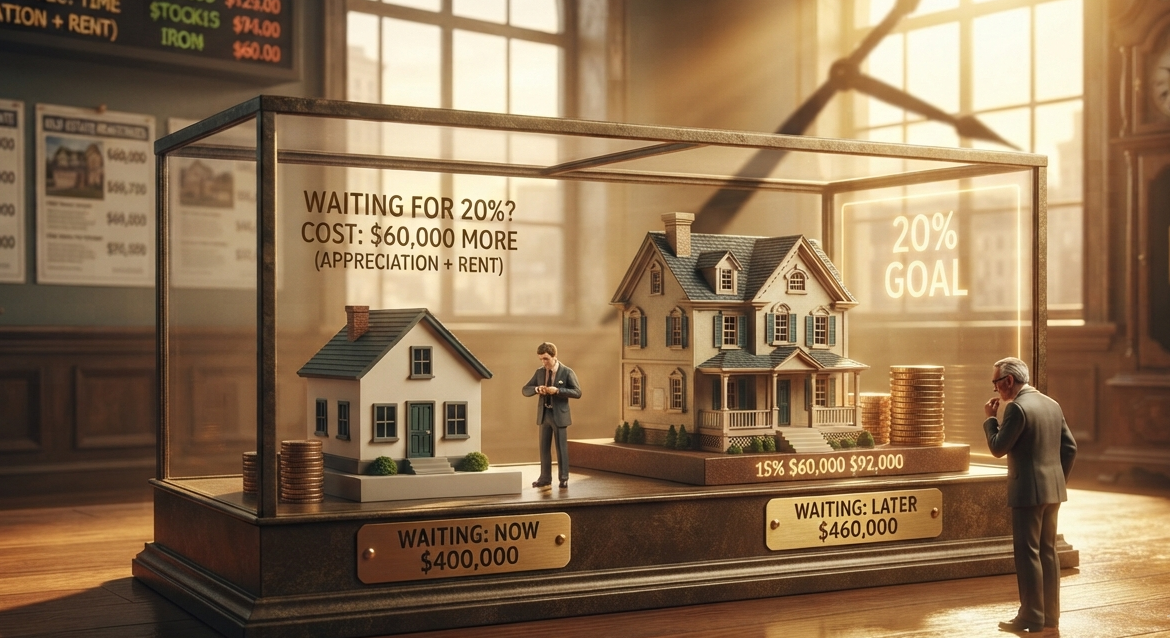
This is the part conventional down payment advice usually skips. Consider someone 28 years old, earning $65,000 a year, with $25,000 already saved, looking at a $250,000 home. Reaching a full 20% down payment ($50,000) means saving another $25,000, at $500 a month, that’s about 50 more months, over four years.
During those four extra years of waiting and renting at $1,000 a month, that’s roughly $50,000 in rent paid with zero equity built. Meanwhile, if that same home appreciates at a modest 3% annually, its price climbs by roughly $31,500 over those four years, meaning the target you’re saving toward keeps moving further away while you wait. Run scenarios at 3%, 5%, 10%, and 20% down side by side, including monthly payment, PMI cost and duration, and total time to save each amount, before assuming the traditional 20% target is actually the better financial decision for your specific situation.
Where Location Changes Everything
National averages are almost meaningless for this specific question, because down payment savings timelines vary enormously by market. The overall seven-year national average obscures markets like San Francisco, where saving for a typical down payment can stretch into decades, versus more affordable regions where a few years is realistic. Down payments themselves have jumped over 50% year-over-year in cities like Newark, New Jersey, while staying far more manageable elsewhere. Your actual timeline should be based on home prices and income levels in the specific market you’re buying in, not the national figure that gets quoted in headlines.
How to Save for a House Down Payment: A Practical Strategy
Once you know how to save for a house down payment strategically, these five moves make the biggest difference. Get pre-approved before you set your savings target. Pre-approval tells you exactly what you can borrow and what down payment your specific lender expects, rather than guessing based on general rules of thumb, and it strengthens your offer once you’re actually competing for a home.
Check your credit score before optimizing your down payment. A 20-point credit score improvement can sometimes move you from a 10% FHA tier to a 3.5% tier, potentially freeing up tens of thousands of dollars that would otherwise need to sit in savings. If your score has room to improve, that may be more valuable than squeezing every extra dollar into your down payment fund.
Look into down payment assistance programs in your specific area. Many require a homebuyer education course, often free and available online, but completing one can unlock thousands of dollars in assistance that most buyers never even check for.
Keep the savings in an account that’s actually earning something. Money sitting in a 0% checking account while you save for years is quietly losing value to inflation the entire time. A high-yield savings account won’t make or break your timeline, but it’s free money for choosing the right place to park funds you already know you’re not touching for years.
Budget for closing costs separately from your down payment. Closing costs typically add another 2-5% of the purchase price on top of your down payment, appraisal fees, title insurance, loan origination fees, and prepaid property taxes. On a $400,000 home, that’s an additional $8,000 to $20,000 that catches a lot of first-time buyers off guard because it isn’t part of the down payment conversation at all.
Finanlytic Takeaway

FINANLYTIC | DATA INTELLIGENCE UNIT | Analysis by Hugo | Lead Market Strategist
How to save for a house down payment isn’t really one question, it’s three: how much do you actually need for your specific loan type and market, how does that amount compare against the real cost of PMI and a smaller loan, and what is waiting for a bigger down payment actually costing you in rent and home appreciation while you save. The traditional 20% target is a reasonable default, not a rule, and for a lot of buyers in 2026’s market, running the actual numbers on a 5-10% down payment tells a more favorable story than the number most people assume they need before they can even start looking.