

Financial Disclaimer: The strategic analysis from the Finanlytic Data Intelligence Unit is meant for informational and educational purposes only. Content created by Hugo Cutillas or other contributors shouldn’t be taken as professional investment, financial, tax, or legal advice. Trading in fast-paced markets carries a significant risk of losing capital. Finanlytic is not a registered financial advisor or broker-dealer. We analyze complex data signals, but remember, just because something worked in the past doesn’t guarantee it will work in the future. Always do your own research and consult with a certified financial professional before making any market moves.
If you run a small business and feel like you’re working harder than ever just to stay in the same place, the data backs you up. For the first time on record, cash flow has overtaken inflation as the single biggest concern among small business owners, but the two problems are tangled together more tightly than most owners realize. Inflation isn’t just making things cost more. It’s quietly rewriting the timing of money in and money out, and that gap is where businesses actually run into trouble.
The Numbers Behind the Squeeze
A recent Small Business Cash Flow Trend Report from OnDeck and Ocrolus, based on 651 small businesses and more than 3.69 million financing applications, found that 31% of owners now name cash flow as their single biggest concern, with inflation close behind at 29%. Notably, 93% of those same owners still expect their business to grow this year, a mix of genuine optimism about demand, paired with real anxiety about the day-to-day mechanics of paying bills.
That tension shows up across nearly every major small business survey in 2026. The U.S. Chamber of Commerce’s Q2 2026 Small Business Index found inflation concern hitting 57%, up from 48% a year earlier, even as the overall index held relatively steady. In the NFIB’s small business survey, the share of owners raising their selling prices jumped to 30%, more than double the historical average, a sign that inflation pressure is being passed along, not absorbed quietly.
Small Business Cash Flow Inflation: Why It Hits Harder Than Rising Prices Alone
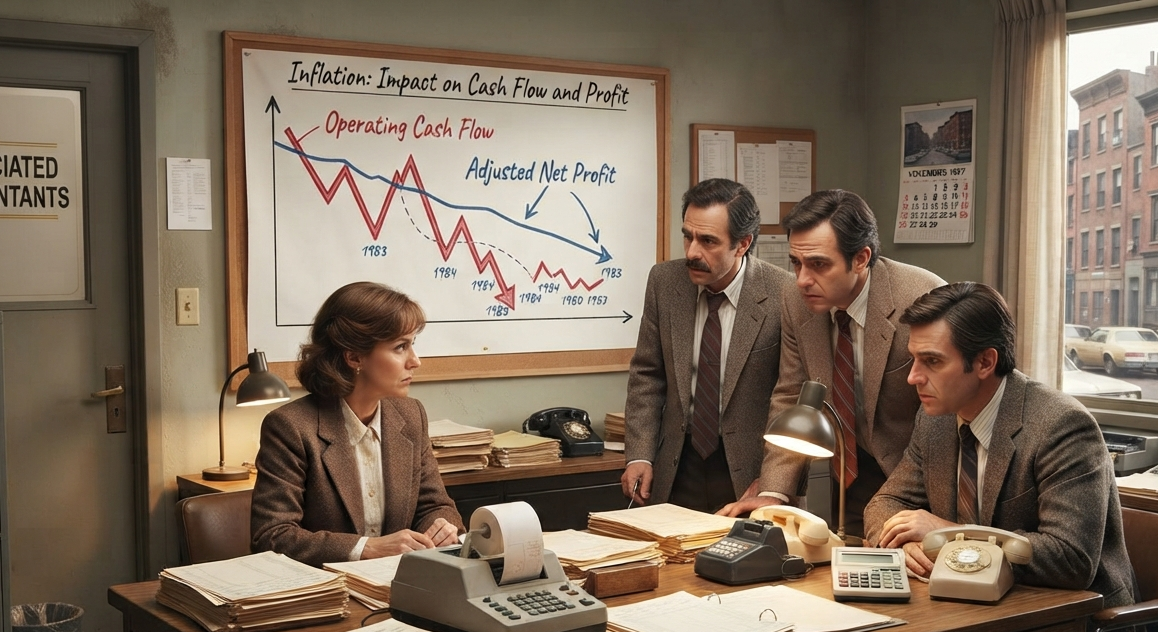
This is the distinction most owners don’t think about until they’re already squeezed. Inflation doesn’t just raise your costs, it changes the timing of when money leaves your business versus when it comes in.
Suppliers tend to raise their prices immediately and expect faster payment. Customers, especially business clients, often take just as long, or longer, to pay their own invoices. That combination means a business can be fully profitable on paper and still run short on actual cash sitting in the bank, simply because the money owed to you arrives weeks after the money you owe others is already due.
Rising interest rates compound this. As the U.S. Chamber of Commerce data shows, inflation concern and interest rate pressure tend to move together, and higher rates mean the credit lines and short-term financing many small businesses lean on to smooth over these gaps become more expensive at exactly the moment they’re needed most.
It Hits Some Industries Much Harder Than Others
The pressure isn’t spread evenly. According to the Chamber’s Q2 2026 data, small businesses in services (66%), retail (59%), and manufacturing (58%) are far more likely to cite inflation as a serious challenge than those in professional services (46%). If you’re running a restaurant, retail shop, or manufacturing operation, you’re statistically facing a tougher inflation environment than a consulting or professional services business right now, worth knowing before you assume your experience matches every other small business owner’s.
There’s a real financing shift happening alongside this pressure too. The OnDeck/Ocrolus data found that 76% of small business owners now report bypassing traditional banks entirely for capital, turning instead to alternative lenders and financing products that can move faster, often at a real cost that’s easy to underestimate if you’re only looking at the monthly payment rather than the total cost of capital.
What Owners Can Actually Do About It
Understanding the mechanics of the squeeze is only useful if it changes how you manage the business day to day. A few concrete moves worth prioritizing:
Track cash flow separately from profit. A profitable month on your income statement doesn’t guarantee you’ll have the cash to cover payroll two weeks from now. Reviewing a rolling 13-week cash flow forecast, not just monthly profit and loss, catches timing gaps before they become emergencies.
Renegotiate payment timing on both sides. Where possible, push supplier payment terms out (net 45 or 60 instead of net 30) while tightening your own customer payment terms or offering small discounts for early payment. Even a modest shift narrows the gap between money out and money in.
Compare the true cost of capital, not just the monthly payment. With more owners turning to non-bank lenders, it’s worth comparing the effective annual cost of financing options carefully, a product that looks manageable month to month can carry a much higher real cost once fees and terms are fully accounted for. The Federal Reserve’s Small Business Credit Survey is a useful, plain-English resource for understanding typical financing conditions.
Build a cash buffer sized to your actual payment gap, not an arbitrary number. If your customers typically pay 45 days after you deliver, your buffer needs to comfortably cover that stretch, not just “a few months of expenses” in the abstract.
Finanlytic Takeaway

FINANLYTIC | DATA INTELLIGENCE UNIT | Analysis by Hugo | Lead Market Strategist
Inflation’s effect on a small business isn’t just “everything costs more”, it’s a timing problem as much as a pricing problem, and that distinction matters for how you respond to it. The businesses weathering this environment best aren’t necessarily the ones with the highest margins; they’re the ones actively managing the gap between when money leaves and when it arrives, and treating that gap as seriously as they treat the top line. With 93% of small business owners still expecting growth this year, the opportunity is real, but so is the cash flow pressure standing between that optimism and the bank balance to support it.
Understanding how small business cash flow inflation actually works, as a timing problem, not just a pricing one, is what separates owners who adapt from those who get caught off guard.