

Financial Disclaimer: The strategic analysis from the Finanlytic Data Intelligence Unit is meant for informational and educational purposes only. Content created by Hugo Cutillas or other contributors shouldn’t be taken as professional investment, financial, tax, or legal advice. Trading in fast-paced markets carries a significant risk of losing capital. Finanlytic is not a registered financial advisor or broker-dealer. We analyze complex data signals, but remember, just because something worked in the past doesn’t guarantee it will work in the future. Always do your own research and consult with a certified financial professional before making any market moves.
Wise vs Revolut vs N26 is one of the most searched comparisons in fintech right now, and for good reason, all three dominate this space in 2026. Most comparisons stop at “which app looks nicer.” That’s the wrong question. The right one is: which of these actually protects your money when it crosses a border? That’s what this guide answers, with real fee structures, not marketing claims
Why This Comparison Matters More in 2026
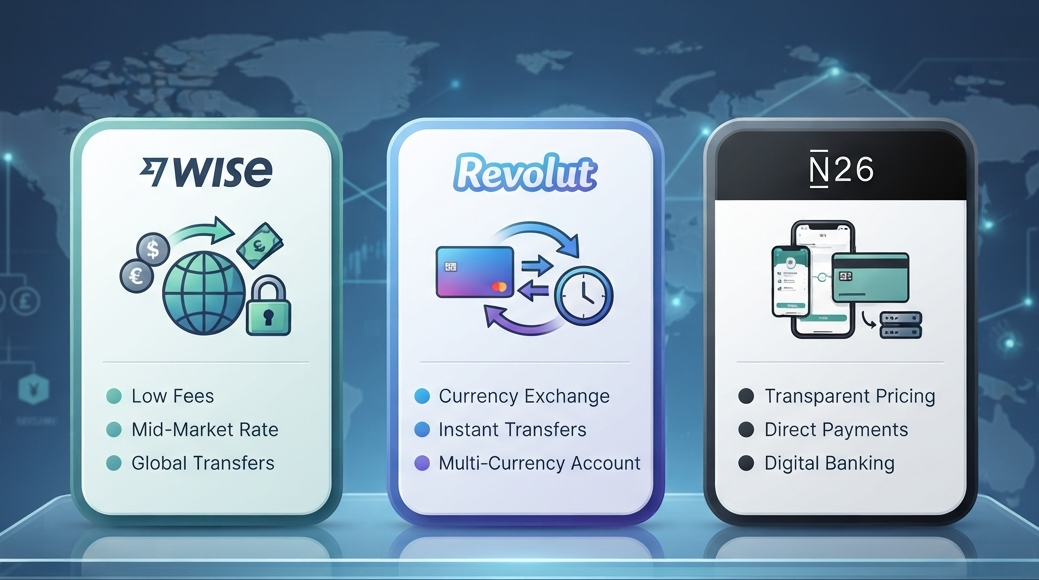
Currency volatility hasn’t gone away, and neither has the temptation for banks to bury their margin inside an exchange rate instead of a visible fee. A “free” transfer that quietly marks up the exchange rate by 3-4% can cost you more than a transfer with a clearly stated 0.5% fee. This is the single most important thing to understand before comparing any of these three services: the sticker price is not the real price.
Each of these three platforms takes a fundamentally different approach:
- Wise was built specifically to solve international transfers, and everything about its pricing reflects that focus.
- Revolut is a spending and banking app that happens to also do foreign exchange — a different starting point that shapes its whole fee structure.
- N26 doesn’t compete on international transfers at all. It quietly hands the job to Wise behind the scenes.
That last point alone changes how you should think about this comparison.
Quick Verdict (If You’re in a Hurry)
Wise wins for international transfers, receiving payments, and exchange rate transparency, while Revolut wins for daily spending, the app experience, and extra features like crypto and insurance. N26 isn’t really competing in the transfer category at all, it handles international transfers through a Wise integration built into its own app, meaning the underlying rates and fees you get are Wise’s, not N26’s.
If you only remember one sentence from this article, make it this one: for large or frequent international transfers, Wise is very likely your cheapest option. For daily spending and small, occasional currency exchange, Revolut can be effectively free.
Wise: The Specialist
Wise (formerly TransferWise) was built around one core promise, it doesn’t add a markup on top of the exchange rate, using the real mid-market rate and charging a transparent, separate fee instead. That fee starts at roughly 0.41% of the transfer amount, though the exact figure depends on the currency pair and route.
To put that in concrete terms: a $10,000 transfer costs around $53.91 on Wise, compared to roughly $75 on Revolut’s Standard plan. On larger amounts, that gap only grows, because Wise’s fee stays flat as a percentage while it doesn’t stack a weekend markup or hidden spread on top.
Speed is also a genuine strength here. 64% of all Wise transfers arrive in under 20 seconds, and 95% arrive within a day. For anyone who has waited three business days for a traditional international wire to clear, that’s not a small thing.
Where Wise falls short: it isn’t really a bank. It focuses primarily on currency exchange and lacks traditional banking features like overdrafts or loans. If you want one app to handle your salary, rent payments, and international transfers, Wise alone won’t cover it.
Revolut: The All-Rounder
Revolut takes the opposite approach. It’s the better daily spending companion, thanks to a polished app, spending analytics, fee-free card payments, and bundled extras like insurance and crypto trading.
For currency exchange specifically, Revolut’s free Standard plan gives you the interbank rate with no markup on a free monthly allowance of roughly $1,000, which makes it genuinely cost-effective for smaller, occasional transfers. The catch that trips up a lot of people: the free plan adds a 1% surcharge on all currency exchanges from Friday 5pm to Sunday 6pm ET, so a $2,000 weekend transfer costs an extra $20 compared to doing it on a weekday.
Once you go over that free monthly allowance, the economics flip. Wise’s roughly 0.5% fee with zero markup consistently beats Revolut’s combined rate-and-fee structure on larger transfers.
Where Revolut wins outright: small, frequent amounts. Sending $100 costs about $0.50 on Revolut versus roughly $4.66 on Wise, a meaningful difference if you’re regularly splitting bills or sending pocket money internationally.
N26: Not Actually a Transfer Competitor
This is the part most comparisons get wrong. N26 is a genuinely good digital bank, it’s a licensed German bank with deposits protected up to €100,000 under the German Deposit Guarantee Scheme, but it was never built to compete on international transfers.
For any transfer outside the SEPA euro zone, N26 routes you through its partner Wise and you pay Wise’s fees directly. In other words, if you use N26 for an international transfer, you are using Wise, just with an extra layer between you and the actual service doing the work.
Where N26 does have its own separate pricing is currency conversion on card payments and ATM withdrawals, and here it’s noticeably less competitive: N26’s Standard and Smart plans use Visa’s exchange rate plus a 1.7% fee, which is not competitive for foreign exchange, only the paid Go and Metal plans bring that down to 0%.
N26’s plans, for reference: the Standard account has no monthly fee, while Smart, Go, and Metal cost €4.90, €9.90, and €16.90 per month respectively.
Wise vs Revolut vs N26: Side-by-Side Fees Comparison

DATA INTELLIGENCE UNIT
| parameters | Wise | Revolut (Standard) | N26 (Standard) |
|---|---|---|---|
| International transfer fee | ~0.41-0.5% of amount | Up to 5% or $10 flat, whichever is higher | Routed through Wise (Wise’s fee applies) |
| Exchange rate | Mid-market rate, always | Interbank rate on weekdays only | Visa rate + 1.7% markup |
| Weekend surcharge | None | +1% on FX (free plan) | N/A (uses Wise’s schedule for transfers) |
| Monthly account fee | Free | Free (paid tiers from ~€7.99) | Free (paid tiers €4.90-€16.90) |
| Currencies held | 40+ | 25+ for transfers, more for holding | EUR only |
| Best for | Large or frequent international transfers | Daily spending, small FX, extra features | Everyday German/EU banking |
Fees and plan structures change over time, always check each provider’s current pricing page before a large transfer.
So Which One Should You Actually Use?
The honest answer is that this isn’t really a three-way fight, it’s two different jobs, and N26 was never applying for the international-transfer job in the first place.
- Choose Wise if: you regularly send money across currencies, especially in larger amounts, or you get paid in a foreign currency and need to receive it without losing a chunk to a bad exchange rate.
- Choose Revolut if: your foreign exchange needs are small and frequent, you want one app that also handles budgeting, crypto, or travel insurance, and you can remember to avoid exchanging on weekends.
- Choose N26 if: you need a genuine EU bank account for salary, rent, and daily spending, and treat its international transfer feature as “using Wise with extra steps,” not as a reason to choose N26 over Wise directly.
Plenty of people end up using two of these together, Wise as the financial backbone for receiving payments and large transfers, Revolut as the daily wallet for card spending and budgeting, and there’s no cost to keeping both open. That combination alone probably covers 90% of what most readers of this article are actually trying to solve.
Finanlytic Takeaway

FINANLYTIC | DATA INTELLIGENCE UNIT | Analysis by Hugo | Lead Market Strategist
Don’t compare these three apps on features or app design, compare them on what happens to your money the moment it crosses a currency line. Wise built its entire business on being transparent there, and it shows in the numbers. Revolut is excellent for daily use and small exchanges, but its pricing rewards you for staying under the free allowance and punishes you for weekend transfers. N26 is a genuinely solid bank for everyday life in Europe, but for the specific question this article set out to answer, sending money abroad, it’s simply reselling Wise’s service to you.
If inflation and currency devaluation are already eating into your savings, losing an extra 1-3% every time you move money between currencies is the kind of leak that’s entirely avoidable. Pick the tool built for the job.