
Financial Disclaimer:The strategic analysis from the Finanlytic Data Intelligence Unit is meant for informational and educational purposes only. Content created by Hugo Cutillas or other contributors shouldn’t be taken as professional investment, financial, tax, or legal advice. Trading in fast-paced markets carries a significant risk of losing capital. Finanlytic is not a registered financial advisor or broker-dealer. We analyze complex data signals, but remember, just because something worked in the past doesn’t guarantee it will work in the future. Always do your own research and consult with a certified financial professional before making any market moves.
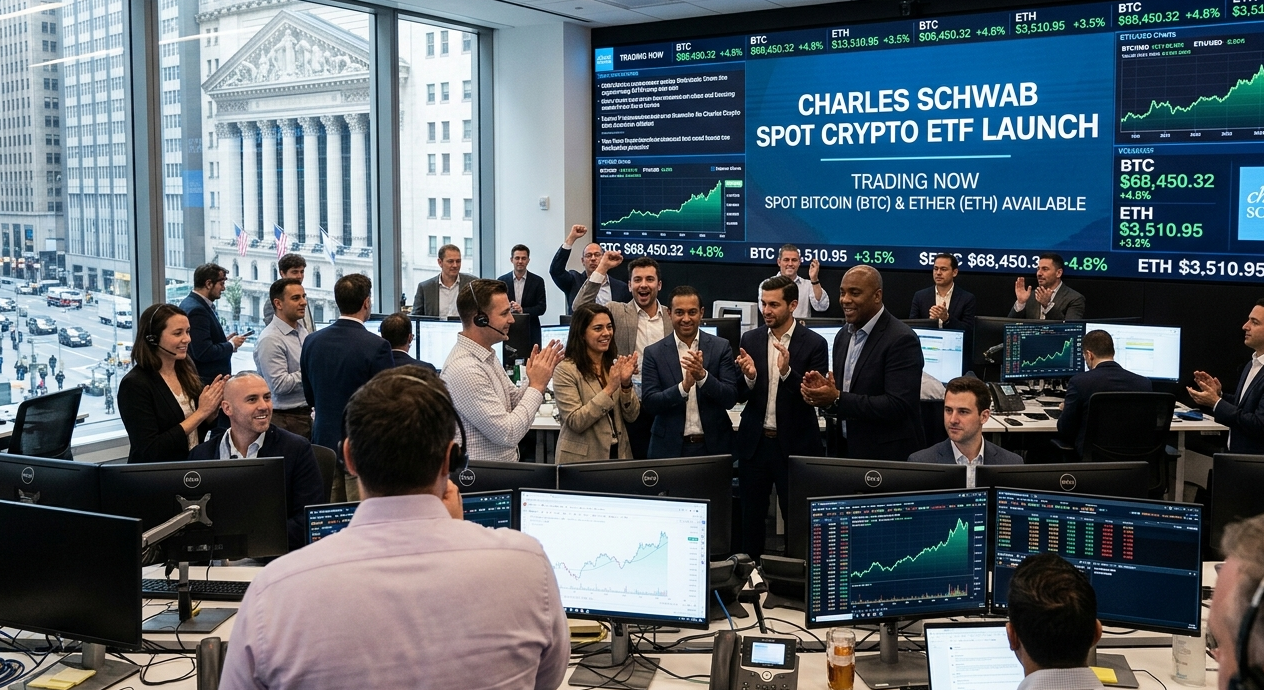
The headlines on April 16, 2026, are buzzing about a “historic milestone.” Charles Schwab, a powerhouse managing over $8 trillion in assets, has just opened the doors for everyday folks to trade Bitcoin and Ethereum. For those who aren’t in the know, this might seem like the ultimate stamp of approval for digital assets.
But here at Finanlytic, we dig deeper; we examine the underlying systems. This isn’t a win for decentralization; it’s what we call the Great Capture. As we move through this era of Fiscal Dominance, the timing of this launch is no accident, it’s a strategic play to keep your money within the reach of the “Silent Tax.”
The Titanic and the Lifeboats: A Game of Control
To really grasp what April 2026 has in store, you need to dive into the financial situation of the G7 countries. With their debt-to-GDP ratios hovering around 120%, these nations are essentially in a state of insolvency. They can’t pay off their debts through genuine economic growth, so inflation becomes their go-to solution.
One of the biggest worries for governments is a potential “mass exodus” into assets that are beyond their control. Cryptocurrencies like Bitcoin and Ethereum were created to serve as the “lifeboats” for the global economy, safe havens that let people escape a currency that’s losing value. By introducing spot trading at Schwab, Wall Street is essentially bringing those lifeboats back onto the Titanic.
The plan is straightforward: If you keep your “inflation hedge” within a regulated brokerage, the government won’t need to outright ban Bitcoin. They just have to impose regulations on the platform.
The Invisible Cage
The “Silent Tax” of inflation only takes effect when your money has nowhere to escape. Under Fiscal Dominance, the Treasury pressures the Central Bank to keep interest rates unnaturally low while prices keep climbing. This is what we call Financial Repression. When Schwab and Goldman Sachs step into the crypto arena, they’re not handing you freedom; they’re luring you in with convenience as a trap.
The Custody Illusion: When you purchase “spot” through Schwab, you’re simply swapping one ledger for another. You don’t hold the private keys; you’re just holding onto a digital promise.
The Liquidity Trap: During a systemic crisis, “paper” crypto held with a traditional broker can be frozen, subjected to “haircuts,” or hit with emergency windfall taxes.
Surveillance Capitalism: By transferring your Bitcoin to a mainstream broker, you’re essentially delivering your “exit strategy” right to the Treasury’s data units.

DATA INTELLIGENCE UNIT: THE CAPTURE MATRIX
| Metric | TradFi Narrative | Finanlytic Reality (2026) |
| Retail Access | “Mass Adoption” | Centralized Capture of Exit Ramps |
| Institutional Liquidity | “Price Stability” | The End of Uncorrelated Returns |
| Regulatory Approval | “Safety & Compliance” | Infrastructure for Future Confiscation |
| Systemic Integration | “Financial Evolution” | The Neutralization of “Anti-Money” |
The “Barbell Economy” and the Middle Class
The launch by Schwab is really pushing forward the “Barbell Economy” that we’ve been observing all year. On one end, you have the Sovereign Giants, those big-name firms and brokers that act almost like extensions of the government. On the flip side, there are the Liquidity Famished, those innovative companies and individuals who are struggling under the weight of high real costs. Wall Street wants you to think that “institutional grade” equates to “safer.” But come 2026, that couldn’t be further from the truth. “Institutional grade” actually means your assets are now part of the collateral pool that the government relies on to cover its own financial troubles.
As this historic day unfolds, you can monitor the real-time data and official statements directly from the source: Charles Schwab Announces Details of Spot Crypto Trading Launch
Behavioral Finance: The Myth of the “Safe” Broker
In a world where Fiscal Dominance reigns, the focus shifts from “Return ON Capital” to “Return OF Capital.” Here’s the Q&A that mainstream media won’t touch:
Is my Bitcoin safer at Schwab?
Only if you have faith in the entity that’s actively devaluing the currency it’s priced in.
Why is the price climbing to $75,000?
Because the system needs a “honey pot” that’s enticing enough to draw in the last of the retail holdouts into the regulated fold.
Building Physical Sovereignty
To dodge the “Silent Tax,” you need to dig a little deeper than just hitting the “Buy” button on your Schwab dashboard. Achieving true capital resilience in the latter half of 2026 means embracing Physical Sovereignty.
Own the Atoms, not the Bits: If you don’t have the keys to your Bitcoin, you’re not really safeguarding against inflation; you’re just holding onto a piece of a crumbling system.
Steer Clear of Jurisdiction Risk: Keeping all your “sovereign” assets in a debt-ridden G7 country is like rolling out the welcome mat for the taxman to become an unwelcome business partner.
Spot Fortress Balance Sheets: Look to invest in companies that create their own cash flow and aren’t dependent on the Central Bank’s “ATM.”
Finanlytic Takeaway
FINANLYTIC | DATA INTELLIGENCE UNIT | Analysis by Hugo | Lead Market Strategist
In 2026, the old saying “Don’t fight the Fed” has morphed into “Don’t let the Treasury own your exit.” Wall Street didn’t just hop on the crypto bandwagon; they took it over to control the outflow of capital. The launch by Schwab marks a significant moment in what we’re calling The Great Capture. The system is insatiable, and it’s just crafted a fancier cage to keep your savings on the menu.
In this market, the winners are those who value physical control over the allure of digital convenience. The real power lies in the assets that they can’t touch, freeze, or dilute.
So, will you be the feast, or will you be the one who walked away from the table?