
Financial Disclaimer: The strategic analysis from the Finanlytic Data Intelligence Unit is meant for informational and educational purposes only. Content created by Hugo Cutillas or other contributors shouldn’t be taken as professional investment, financial, tax, or legal advice. Trading in fast-paced markets carries a significant risk of losing capital. Finanlytic is not a registered financial advisor or broker-dealer. We analyze complex data signals, but remember, just because something worked in the past doesn’t guarantee it will work in the future. Always do your own research and consult with a certified financial professional before making any market moves.
In early 2026, we’re witnessing a remarkable transformation in the market. Conversations about production targets and quarterly delivery figures are starting to take a backseat. Tesla has grown beyond its roots as a groundbreaking car manufacturer, evolving into a comprehensive technology, robotics, and energy powerhouse. These days, its valuation isn’t just about car sales anymore. Investors are now paying closer attention to the company’s advancements in areas like scaling neural networks, automation, and its strategic role in the global shift towards renewable energy.

DATA INTELLIGENCE UNIT
| Segment | 2020 Focus | 2026 Reality |
| Core Revenue | Vehicle Deliveries | AI Software & Energy Storage |
| Data Moat | Production targets | 8.4B+ FSD Miles Driven |
| Infrastructure | Supercharger Network | Virtual Power Plants (VPP) |
| Labor Future | Human Assembly Lines | Optimus Gen 3 Robotics |
The AI Transformation: Data as the New Structural Moat
In 2026, the narrative around Tesla’s valuation is increasingly being shaped by its connection to AI. While traditional car manufacturers are still grappling with integrating advanced software, Tesla’s fleet has already racked up over 8.4 billion miles using its Full Self-Driving (FSD) technology. In this age of AI, having access to data is the key to gaining a competitive edge. Tesla’s vast scale creates a powerful feedback loop, enhanced by the Dojo supercomputer and the cutting-edge AI5 silicon, both of which are designed to speed up the training of systems that function in the real world. As this ecosystem evolves, we’re starting to see higher-margin, software-driven revenue streams begin to surpass the traditionally lower margins associated with hardware manufacturing.
Finanlytic Tech Glossary:
- FSD (Full Self-Driving): Tesla’s neural network-based autonomous software.
- Dojo: A custom supercomputer designed for high-speed video training.
- AI5 Silicon: Tesla’s next-generation in-house chip for autonomous computing.
- Edge Cases: Rare driving scenarios (e.g., a horse on a highway) that only a massive real-world fleet can capture for training.
To help you see how these key technical elements come together, the Finanlytic Data Unit has put together this insightful analysis from Bloomberg. The report highlights how Tesla’s significant advantage in real-world data, harnessed by the Dojo supercomputer, is expected to boost its market valuation by billions as it tackles the last frontier of Artificial Intelligence in the physical realm.
The Sleeping Giant Becomes a Global Utility
While the automotive industry grabs most of the headlines, Tesla’s Energy division has been steadily carving out its own niche as a major source of profit. By 2026, the deployment of energy storage systems like Megapack and Powerwall 3 has surged by about 49% year over year. Tesla has evolved beyond just being a battery supplier; it’s now a crucial part of a distributed global utility network. By linking residential batteries into Virtual Power Plants (VPPs), the company plays a vital role in stabilizing power grids in places like Texas, Australia, and Europe. In the first quarter of 2026, this segment boasted gross margins exceeding 30%, far surpassing the more capital-heavy automotive division.
The Valuation Paradox: Pricing in Infinite Optionality
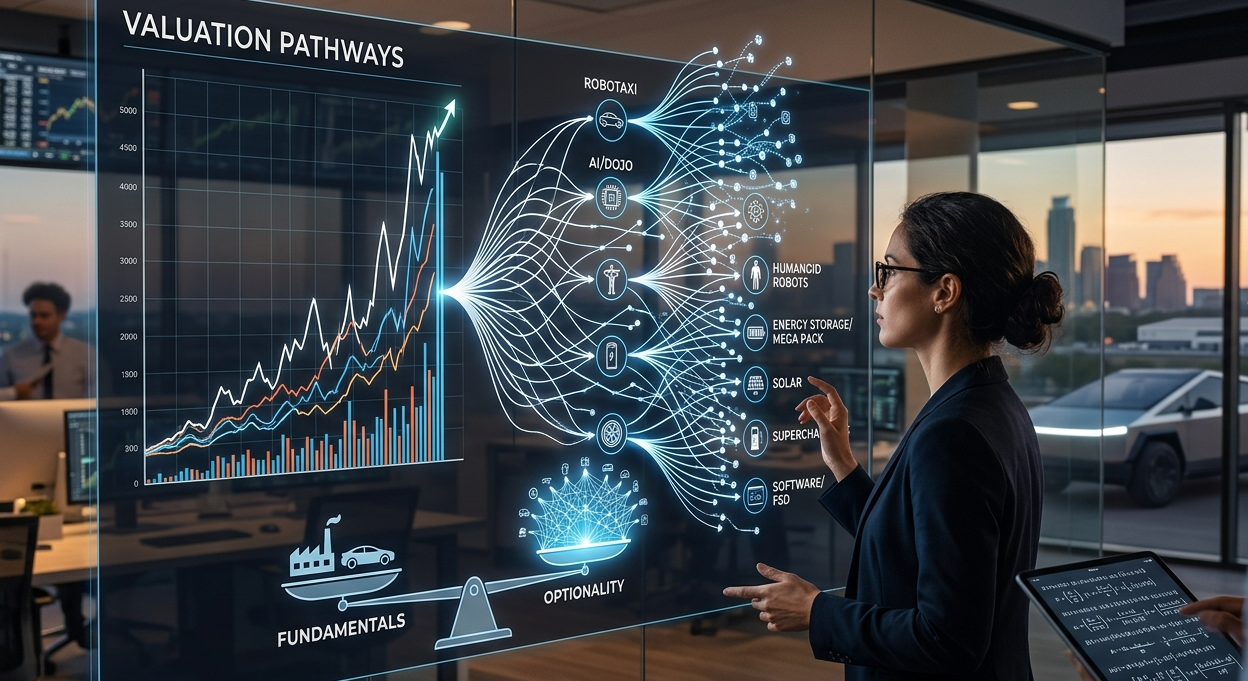
Have you ever wondered why Tesla’s stock trades at such a high multiple compared to giants like Toyota or Volkswagen? The secret lies in something called optionality. While traditional car manufacturers are valued based on their current sales figures, Tesla is seen more like a venture capital portfolio. Investors are factoring in the potential “option value” of scaling up their Robotaxi technology and making significant strides with Optimus Gen 3. This means that Tesla’s valuation is less about its current performance and more about the exciting possibility of owning the most advanced robotics network in the world.
The Musk Premium and Strategic ETF Concentration
Tesla continues to play a crucial role in shaping overall market sentiment, holding a prominent position in both the S&P 500 and Nasdaq-100. Its significant presence in ESG-focused ETFs means it enjoys robust passive capital inflows, which, in turn, leads to a high beta profile, moving 1.5 to 2 times more than the broader market. By 2026, the main risks will have transitioned from manufacturing challenges to the hurdles of regulatory approval and the pace of rolling out the robotics division. These shifts in narrative, rather than any operational setbacks, are now what drive those multi-billion-dollar fluctuations in market value.
Strategy for 2026: Balancing Long-Term Vision with Market Reality
Investors are broadly split into two camps.
The first group, the fundamentalists, focuses on near-term realities like price competition in China and the pace of EV adoption stabilizing. From their perspective, Tesla is still primarily a car company operating in a highly competitive automotive market.
The second group, the visionaries, looks beyond the current cycle. They focus on milestones from events like “AI Day” and the long-term, almost exponential potential of energy systems. In their view, Tesla is not just a vehicle manufacturer, but the foundational hardware layer for what could become one of the world’s most valuable software-driven networks.
Finanlytic Takeaway
FINANLYTIC | DATA INTELLIGENCE UNIT | Analysis by Hugo | Lead Market Strategist
Tesla stands at the crossroads of industrial manufacturing and a state-of-the-art AI lab. By 2026, the real treasure isn’t just the car parked in your driveway; it’s the network intelligence that it contributes to. One of the main challenges is the timing gap between the slowdown of the traditional electric vehicle cycle and the full-scale rollout of autonomous driving. But if you take a step back, owning the means of automated production is the best long-term safeguard in an inflationary climate. Having control over production systems is more significant than traditional asset classes.
You’re not merely investing in a car company; you’re investing in the backbone of the next industrial revolution.