Financial Disclaimer:The strategic analysis from the Finanlytic Data Intelligence Unit is meant for informational and educational purposes only. Content created by Hugo Cutillas or other contributors shouldn’t be taken as professional investment, financial, tax, or legal advice. Trading in fast-paced markets carries a significant risk of losing capital. Finanlytic is not a registered financial advisor or broker-dealer. We analyze complex data signals, but remember, just because something worked in the past doesn’t guarantee it will work in the future. Always do your own research and consult with a certified financial professional before making any market moves.
In the fast-moving financial world of 2026, AI-driven education is transforming more than just the way we learn; it’s breaking down the barriers to wealth like never before. For years, the “Information Advantage” kept the elite in a league of their own. But now, the days of having to wait until graduation, or until you’ve built a million-dollar portfolio, to grasp the market are long gone. Artificial intelligence is stepping in as the great equalizer. It connects the dots between dry academic theories and the harsh, fast-paced reality of global markets. We’re in the midst of a revolution where Adaptive Intelligence serves as a top-notch coach, enabling anyone to absorb a decade’s worth of institutional-level expertise in just a few hours.
The Hyper-Personalized AI Tutor: Solving the Conceptual Gap
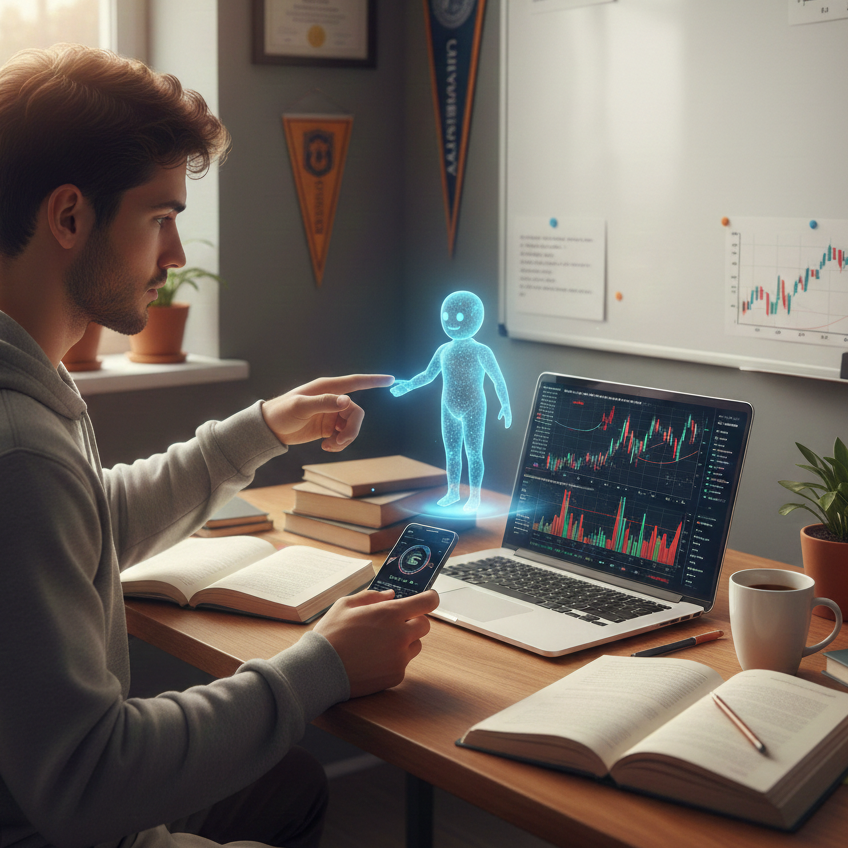
Traditional education has its flaws, mainly because it often follows a “one-size-fits-all” approach. It assumes that everyone learns in the same way and at the same pace. However, by 2026, adaptive learning systems are set to change that. These AI-powered platforms go beyond just repeating definitions. They dive into your unique learning patterns, pinpointing where you might struggle and why. For instance, if a student or a new investor finds the idea of “Short Selling” confusing, the AI won’t just direct them to a glossary. Instead, it might explain the concept through something relatable, like the resale market for limited-edition sneakers or trading rare skins in a gaming environment.
By connecting complex financial ideas to real-life examples that resonate with your experiences, the AI helps make these concepts not only easier to grasp but also more memorable.
The days of passive learning are behind us. As we step into 2026, the true edge for students comes from moving away from just absorbing static information and diving into the world of Adaptive Intelligence. This briefing highlights how AI is doing more than just crunching numbers; it’s stepping up as a top-notch coach, helping to connect the dots between financial theory and real-world execution at an institutional level.
One of the biggest challenges investors face, often without even realizing it, is the need for emotional discipline. You can’t just pick up “diamond hands” during a market crash by skimming through a PDF. Investing is largely about psychology, and until now, the only way to truly learn was by losing actual money. But the 2026 generation of AI Portfolio Simulators is here to shake things up.
These innovative tools go way beyond basic “paper trading” by incorporating real-time news feeds and Generative Market Sentiment. The AI can even introduce a synthetic “black swan” event into your simulation to see how you handle stress. With Neural Feedback Loops, the AI uncovers your hidden behavioral biases, like the Sunk Cost Fallacy, giving you the chance to experience the emotional rollercoaster of a decade’s worth of market cycles before you ever make your first real trade.
Leveling the Information Playing Field with Financial LLMs
In the past, Wall Street had a tight grip on data, backed by a whole team of analysts who would comb through every 10-K filing and tune into every earnings call. Fast forward to 2026, and specialized Financial Large Language Models (LLMs) have completely shaken up that monopoly. Now, instead of spending weeks trying to make sense of a complicated balance sheet, you can use tools like Claude 4.6 or tailored Excel add-ins to automate the tedious data extraction process.
This means you can focus on the questions that really count: “Can you compare the debt-to-equity ratios of these five EV companies and point out which one might be most at risk if interest rates rise in Q3?” By letting AI take care of the heavy lifting, you can dedicate 90% of your time to Strategic Decision-Making. You’ve transformed from just crunching numbers into a strategic architect, which is exactly what today’s job market and the economy of 2026 are looking for.
Ethical AI and the Challenge of the “Black Box”
True mastery is all about knowing when to lean on the tools at your disposal and when to trust your own instincts. These days, top-notch financial savvy means grasping the nuances of algorithmic bias. If you’re relying entirely on a robo-advisor without understanding how it works, you’re not really investing; you’re just watching from the sidelines. The 2026 revolution aims to foster collaboration between humans and AI. Humans bring the ethical considerations, the long-term vision, and that all-important gut feeling, while AI delivers the heavy-duty computational power.
In 2026, the risk isn’t using AI to invest; the risk is competing against those who do. Financial literacy has moved from the library to the neural network.
Finanlytic Takeaway
FINANLYTIC | DATA INTELLIGENCE UNIT |Analysis by Hugo | Lead Market Strategist
The classroom has transformed into more than just a space for learning; it’s now a launchpad for future success. AI isn’t just a “cheat code”, it’s like a high-performance training suit that enhances your natural abilities. As the first generation that’s grown up with AI steps into the workforce, we’re witnessing a significant shift in how wealth is built. Those who start investing at 18 with AI-assisted portfolios have a ten-year head start compared to those who wait until they’re 28.
In 2026, the real risk isn’t about using AI for investing; it’s about being the one who doesn’t. Financial literacy has evolved from dusty library books to dynamic neural networks. Take advantage of this rapid change to carve out your niche in the global economy, or you might find yourself stuck in the past.