
Financial Disclaimer: The strategic analysis from the Finanlytic Data Intelligence Unit is meant for informational and educational purposes only. Content created by Hugo Cutillas or other contributors shouldn’t be taken as professional investment, financial, tax, or legal advice. Trading in fast-paced markets carries a significant risk of losing capital. Finanlytic is not a registered financial advisor or broker-dealer. We analyze complex data signals, but remember, just because something worked in the past doesn’t guarantee it will work in the future. Always do your own research and consult with a certified financial professional before making any market moves.
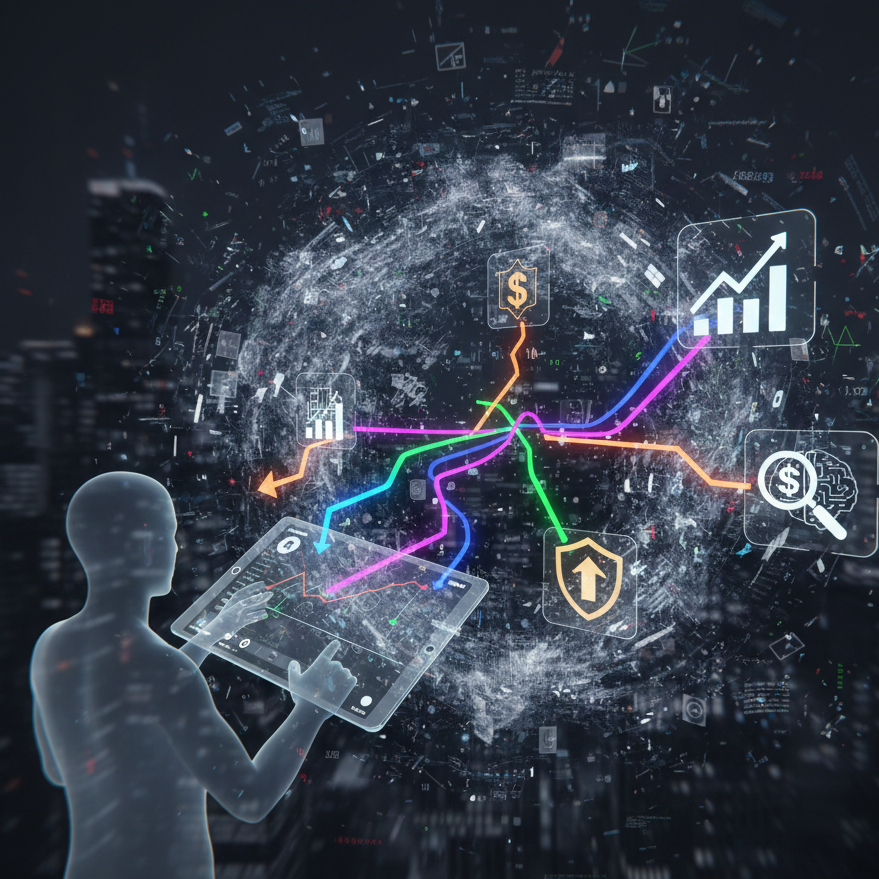
Information has evolved from a resource to a weaponized wave of volatility in today’s financial environment. An unstoppable wave of “breaking news,” terminal alerts, and social media sentiment hits markets every second, with the potential to quickly cause billion-dollar liquidations. For those who are not familiar with it, this setting appears to be utter chaos.
At the Finanlytic Data Intelligence Unit, however, we acknowledge that the majority of publicly available information is actually “lagging data.” The “Smart Money” has already left their positions by the time a story appears on your favorite financial portal or the evening news, leaving retail investors as the Exit Liquidity. Gaining proficiency in market signals is more than just trading; it’s the ability to see the invisible before it’s made public.
The Death of Guesswork: Moving Toward Quantitative Precision
The days of trading based on subjective chart interpretation and “gut feelings” are officially over. Investors relied on manual price pattern analysis and personal experience for decades, but intuition is a liability in a world where high-frequency algorithms rule. The market in 2026 has been re-engineered through data science, transforming price action from a “random walk” into a series of logical, predictable outcomes based on hidden variables. We no longer ask what the price is doing; we ask what the data is signaling about where the price is being forced to go.
Think about two different kinds of people who are in the market. The first person reacts emotionally to every “tick,” buying because they are afraid of missing out and selling in a panic when the headlines turn red. The strategist, the second participant, uses advanced signals to find Institutional Order Flow and Liquidity Gaps days before they show up on a regular retail chart. By the time a news anchor tells the general public to “buy,” the strategist has already taken most of the move and is getting ready to move money into the next opportunity that isn’t being noticed.
AI and Machine Learning: The Signal Revolution
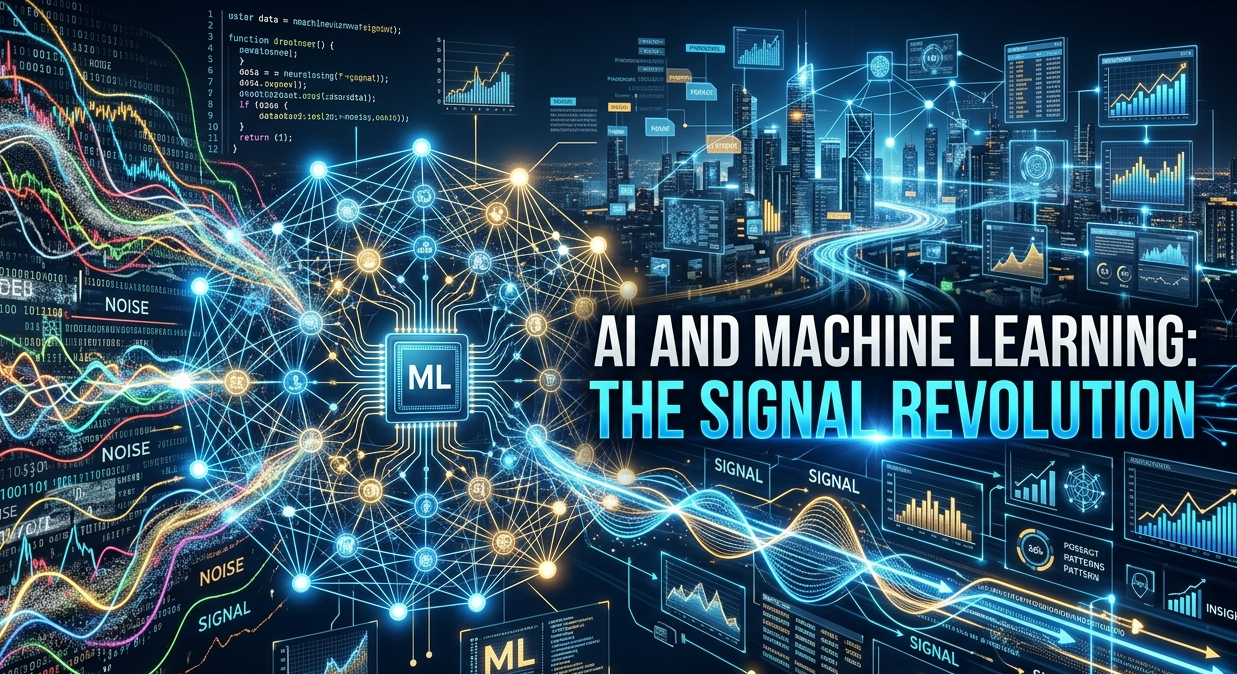
The most important change in 2026 is that Artificial Intelligence will be fully used to combine market signals. AI systems can process millions of unstructured data points in microseconds, from dark pool activity to satellite images of shipping lanes. Human analysts, on the other hand, are limited by fatigue and cognitive bias. These systems don’t just react to changes in the market; they also predict them through Predictive Reflexivity.
These algorithms use Deep Learning to find things that are wrong that people can’t see. For example, Sentiment Analysis can now follow the speed of certain keywords across encrypted networks around the world. This lets it see when investors are losing interest before it shows up in a price candle. Cross-Asset Correlation is another important layer. A strange move in the Japanese bond market or a jump in certain commodity spreads can often be a sign that tech stocks are about to drop a lot. Our AI-driven method sees a domino effect that has already started to fall, while the average person only sees a random news headline.
How Signals Drive Real-World Dominance

In this fast-paced time, signals are what set apart a portfolio that grows from one that is slowly eaten away by “market noise.” A signal-driven strategy is based on four types of institutional-grade intelligence:
Primary Trend Detection: Signals help us find structural changes as they happen. The goal is to get in when the risk-to-reward ratio is best, well before the news media starts reporting on it.
Timing and execution of algorithms: it’s not just about the “what,” but also the “how.” Signals keep an eye on “iceberg orders” and market depth to make sure that entry and exit points are as good as they can be to avoid being front-run by bots that want to steal your money.
Predictive Risk Management: You can think of signals as a digital immune system. When a signal “breaks” or shows a divergence, it tells you in a cold, logical way to hedge or cut back on your exposure, turning possible disasters into events that can be controlled and managed.
Behavioral Sentiment Arbitrage: By measuring the levels of extreme greed and fear in real time, we can tell when the market is too high and trade against the irrational crowd to make money when the market corrects itself.
The Dopamine Hit: The Psychology of the Signal
The feeling aspect associated with trading is not often discussed in finance textbooks. This feeling is referred to as the “dopamine effect.” Once someone accurately interprets a signal in the markets, the feeling of satisfaction results from knowing what they know while others don’t.
In 2026, the red days are no longer scary; they are simply data points that inform your next move.
Each successful trade that is backed up by a signal increases the confidence and intuition of the trader. It is this mentality that helps a professional trader to be calm even in highly volatile times. Having a reliable method for getting the signal means that the red days will no longer be frightening since they provide an indication for the next step. The ability to keep your mind focused on what matters is key to creating real wealth.
Challenges: The Danger of False Positives
Still, it must be emphasized that signals are far from being magic cures. Confusion, over-reliance on a single signal, or employing poor-quality data can be extremely detrimental. In such instances, human participation cannot be underestimated. It will not be difficult for computers to work with data. However, people will still be required to figure out the causes behind certain market actions.
Perhaps the most productive way to employ signals would be as part of a bigger picture. Signals ought to be used as something supplementary rather than as something that would replace everything else. The recipe for trading success in 2026 will consist of learning how to discern the difference between fake signals and real ones. Fake signals look attractive at first glance only; nevertheless, their main purpose consists of luring people into traps of market fluctuations. One must admit, as professionals, that we need to give attention both to the signals which we choose and the ones which we ignore. Exclusive reliance on one sort of data is the beginning of the end.
The Future is Signal-Driven
It’s getting harder to ignore where the global economy is heading. Data is now at the center of almost every important decision, and those who choose not to adapt to signal-based trading are basically navigating a storm without the right instruments.
Market signals are reshaping finance. What once felt unpredictable is starting to look more like a space where you can make informed, strategic choices. Over the next few years, the gap between people who use these signals and those who don’t is only going to grow, and not by a little, but significantly.
We’re already witnessing the emergence of a new kind of financial leader: people who understand and work fluently with signals.
Finanlytic Takeaway
FINANLYTIC | DATA INTELLIGENCE UNIT | Analysis by Hugo | Lead Market Strategist
In 2026, the divide between those who simply react to news and those who actually trade based on that information has widened dramatically; it’s no longer just a small gap, but a vast canyon. If you’re waiting for a news alert to confirm something, you’ve already missed the boat.
The market has moved, the profits have been snatched up, and you’re just the one providing the liquidity for others to cash out. The future of wealth is in the hands of those who dig deeper than the surface-level price changes to uncover the real data that counts. Stop fixating on the clock, and start paying attention to the signals.