
Financial Disclaimer: The strategic analysis from the Finanlytic Data Intelligence Unit is meant for informational and educational purposes only. Content created by Hugo Cutillas or other contributors shouldn’t be taken as professional investment, financial, tax, or legal advice. Trading in fast-paced markets carries a significant risk of losing capital. Finanlytic is not a registered financial advisor or broker-dealer. We analyze complex data signals, but remember, just because something worked in the past doesn’t guarantee it will work in the future. Always do your own research and consult with a certified financial professional before making any market moves.
For the middle class, the once-glorious dream of “digital freedom” is quickly morphing into a confining paper cage. While stock indices may seem to soar, the true value of those assets is hitting an invisible yet deadly wall: material scarcity. By 2026, relying solely on software will feel like a liquidity trap. Behind every screen and AI algorithm lies a tangled, violent web of physical resources that can no longer be overlooked. We’ve spent a decade fixated on virtual scalability, but the time of boundless digital growth is over. Welcome to the era of Material Friction, where you can’t scale those walls with just code; you need real assets to make it happen.
The Death of the “Asset-Light” Illusion and the Inflation Theft
For years, we’ve been led to believe that success meant being “asset-light.” This idea was the gold standard for retail investors. But now, Generative AI has completely changed the game. We’re witnessing a groundbreaking clash between the most sophisticated software ever created and a crumbling, outdated electrical grid from the 20th century. For the everyday person, this means we’re facing structural inflation that simply can’t be fixed by just raising interest rates. Electricity has shifted from being a public utility to a strategic commodity. One single AI gigacluster can now use as much power as an entire city, all while our grid infrastructure falls apart.
At Finanlytic, we’re convinced that the companies that will truly safeguard your wealth aren’t necessarily those with the best technology, but rather those that secure the most reliable physical energy contracts. If you don’t own the energy, you don’t own your future.
Escaping the System via the Atomic

Nations and powerful elites are no longer just in a battle for oil; they’re now vying for “Firm Power” to secure their computational independence. This shift has sparked an extraordinary Nuclear Renaissance. The move by tech giants towards Small Modular Reactors (SMRs) and the revival of old nuclear sites isn’t merely a trend, it’s a rallying cry for institutional investors looking to escape the chaos of volatility for something solid.
Unlike the unpredictable nature of renewable energy, nuclear power offers the reliable baseload that our digital world desperately needs. For middle-class investors wanting to protect themselves from currency devaluation, this means turning their attention to the uranium supply chain and specialized engineering companies. Countries that manage to blend nuclear energy with fast, low-latency connectivity will emerge as the new “safe havens” for investment, taking the place of traditional financial hubs that have failed to keep up with modern demands.

DATA INTELLIGENCE UNIT: THE PHYSICAL WALL
| Resource | Strategic Role (2026) | Market Constraint |
| Uranium (U3O8) | Baseline Firm Power | 24/7 AI Requirement |
| High-Purity Copper | Grid Modernization | Multi-year Mine Development Lead Times |
| Electrical Steel | Transformer Manufacturing | Severe “Middle Mile” Bottleneck |
| Silver | Conductive & Industrial | Scarcity vs. Monetary Hedge |
You Can’t “Print” a Transformer: The Reality of the Middle Class
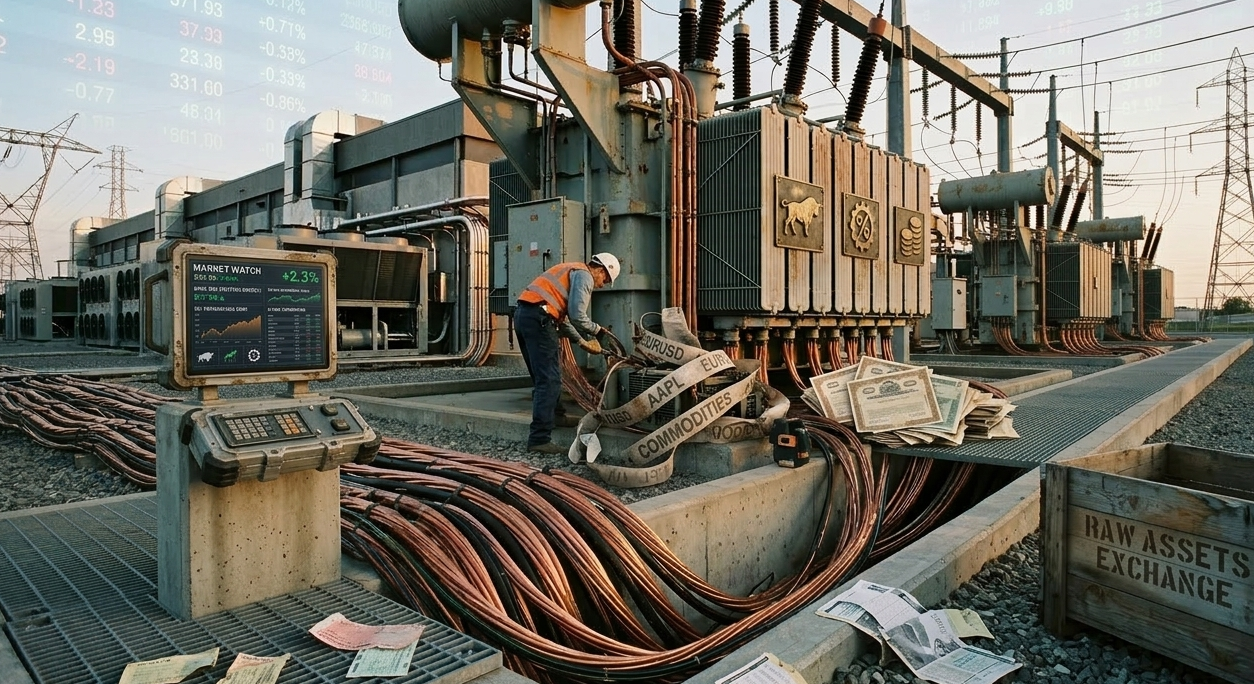
While the media keeps you occupied with discussions about chip architecture, the real issue lies in the “Middle Mile” of the energy sector. The lead times for high-voltage transformers stretch out for years, not just months. This creates a hard limit on economic growth that no amount of money printing by central banks can resolve.
You can’t just print a transformer, nor can you magically create a copper mine. This stark reality is driving a new Commodities Supercycle. Copper, silver, and specialized steel are the essential building blocks of the digital age. Investors who grasp this ongoing shortage of conductive metals will be in a prime position to seize real value when the rest of the market wakes up to the fact that their digital portfolios lack a solid foundation.
The Death of Hype and the Return to Classical Principles
We’re stepping into the true age of Infrastructure-as-a-Service (IaaS). The market is starting to turn on those “hype” companies and is instead favoring those with solid Physical Moats.
But here’s the catch: building reactors and expanding mines demands trillions in upfront investment, all while global interest rates are stubbornly high. This creates what we call the CapEx Paradox: the world is crying out for infrastructure, yet the cost of capital is a tough obstacle to overcome. By 2026, the lines between “Value” and “Growth” will blur. Genuine growth now hinges on having a substantial physical presence. We’re seeing a return to the basics of economics, where land, energy, and labor are the true measures of wealth.
Final Synthesis: Design Your Own Exit
FINANLYTIC | DATA INTELLIGENCE UNIT | Analysis by Hugo | Lead Market Strategist
The lines between the digital and physical worlds are blurring more than ever. The next wave of success won’t be measured by spreadsheets, but by how effectively we turn raw energy into smart actions. In today’s market, “Low Value” is represented by those who overlook these physical realities, while High Value emerges at the crucial crossroads of innovation and infrastructure. While everyone is caught up in the latest viral app, the forward-thinking institutions are busy securing essential resources like copper, uranium, and grid capacity.
At Finanlytic, we aim to cut through the digital noise and uncover the industrial truths that shape our independence. The future is constructed with atoms, not just bits.
If your portfolio feels like it’s hitting a wall, it’s time to stop being the one who crashes into it and start being the one who owns the bricks.