
Disclaimer: The content on Finanlytic is for informational and educational purposes only and does not constitute financial, investment, or career advice. Always consult a qualified professional before making decisions based on this information.
Few questions generate more visceral anxiety in the first quarter of 2026 than the potential for complete human replacement. As artificial intelligence becomes increasingly capable, faster, and more cost-effective to deploy, the fear has migrated from the abstract realm of science fiction directly into the heart of the modern office. The question is no longer a theoretical debate: can AI actually replace human workers? And if it can, what does that mean for our career trajectories, our household salaries, and the very fabric of our economic society? The truth in 2026 is far more nuanced than the apocalyptic headlines of previous years suggested. We are not witnessing a sudden, blunt mass replacement, but rather a granular and systemic restructuring of human labor.
The “Task Erosion” and the Entry-Level Cliff
AI is not coming for every profession simultaneously; instead, it is systematically targeting specific, modular tasks. In the 2026 job market, the most exposed roles are those defined by repetitive, predictable, or high-density data processing. This has led to the emergence of the Entry-Level Cliff. Administrative support, basic data synthesis, and junior analytical positions are increasingly being absorbed by specialized, domain-specific LLMs. This creates a profound structural crisis: if AI handles all the “stepping stone” tasks, how do young professionals gain the foundational experience required to eventually become senior experts? This obstruction of the traditional career path is a primary driver behind the uncomfortable reality that a good salary doesn’t go as far anymore, as the route to higher-value wages becomes increasingly steep and difficult to navigate.
Replacement versus Transformation: The Mosaic of Labor
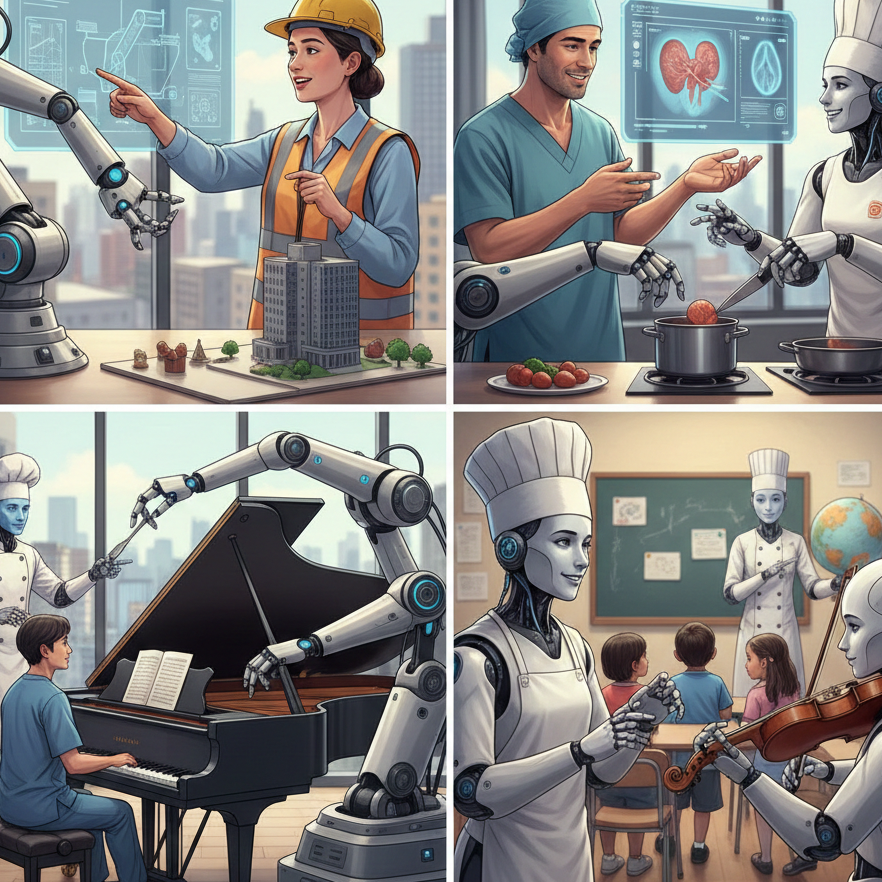
The most critical insight for the 2026 professional is that a “job” is not a monolith; it is a mosaic of dozens of distinct actions and responsibilities. While an AI agent may excel at 40% of those actions—such as document drafting or data visualization—it continues to struggle with the remaining 60% that require high-context judgment. This is best seen in the evolution of specialized fields. A bookkeeper’s role has been largely automated, yet the demand for strategic tax planning remains a human-led endeavor. Similarly, while contract examination is now performed in seconds by AI, courtroom strategy and the delicate nuances of high-stakes negotiation still require human intellect and intuition. In the majority of cases, AI does not abolish the employee; it transforms the role. Those who embrace Human-AI Collaboration become “Super-Employees,” while those who resist face rapid marginalization.
The Hidden Threat of Wage Compression and Salary Stagnation
Even in sectors where a job is not fully replaced, AI introduces a subtle but devastating challenge: Wage Compression. Because AI can now handle a significant portion of a role’s daily duties, a single skilled individual can manage a workload that previously required a team of three. While this massive boost in productivity is highly beneficial for corporate profit margins, it simultaneously reduces the individual worker’s “bargaining power.” In 2026, many professionals find themselves in a state of Salary Stagnation; the surplus value created by AI implementation rarely trickles down to the employee’s paycheck. This creates a disconnect where workers are more productive than ever, yet their real-world purchasing power continues to erode under the weight of a permanent high-cost baseline.
The Human Moat: Why Emotional Intelligence is the New Hard Skill
Despite the immense hype surrounding generative models, AI in 2026 continues to hit a cognitive wall when faced with high-context human interaction. This forms what we call the Human Moat, a collection of skills that remain resilient to automation. This moat consists of Emotional Intelligence—the ability to build trust, empathy, and resolve complex interpersonal conflicts—and Ethical Responsibility. While a machine can calculate a risk/reward ratio, it cannot take moral accountability for a decision. Furthermore, Ambiguous Decision-Making in the face of “black swan” events, where no historical data exists for the AI to reference, remains a purely human domain. Consequently, visionary leaders, healthcare professionals, and skilled negotiators are seeing their value appreciate in an increasingly automated world.
The Skills Mismatch and the Psychological Toll of Irrelevance
The risk in 2026 is not necessarily a total lack of jobs, but a profound Skills Mismatch. History shows that technological revolutions birth entirely new roles—such as AI Auditors, Prompt Orchestrators, and Human-AI Ethics Officers—but the speed of the current AI revolution far outpaces the adaptability of our traditional educational systems. This creates a friction where new roles require a level of technical and creative synthesis that takes years to develop. Beyond the economic disruption, there is a heavy psychological toll. Work is more than a paycheck; it is a pillar of identity. When machines outperform humans at complex cognitive tasks, it triggers a silent, existential pressure to “upskill or die,” which often reduces long-term wealth planning as individuals focus purely on surviving the next wave of automation.
The Multiplier Strategy: How to Stay Relevant in 2026
Resisting the integration of AI in 2026 is a losing battle, akin to resisting the adoption of the internet in the mid-1990s. The only winning strategy is to view AI as a Skills Multiplier. This involves mastering the tools to automate the “grunt work” of your profession while doubling down on the “Synthesis” of ideas across different fields—a feat AI still struggles to perform authentically. In an automated world, “soft skills” have become the new “hard skills.” By cultivating a diverse range of abilities that machines cannot replicate—leadership, empathy, and strategic intuition—you ensure your positioning remains secure. As we have seen across our analysis of Market Signals, success in the modern economy is determined by your ability to act on information faster than the crowd, and AI is the ultimate tool for that acceleration.
Finanlytic Takeaway
The reality of 2026 is that AI will not replace “humans,” but humans who use AI will replace those who do not. The labor market is shifting from a model of time-based compensation to one of Value-Based Synthesis. To protect your financial future, you must pivot from being a “task-doer” to becoming a “strategic orchestrator.” By building your own Human Moat and leveraging AI as a multiplier for your unique insights, you can navigate the restructuring of the workforce not as a victim of replacement, but as a leader of the new economic era. The rules of work have changed, and the prize now goes to those who can effectively harmonize human judgment with machine speed.