
Disclaimer: The content on Finanlytic is for informational and educational purposes only and does not constitute financial or investment advice. Always consult a qualified professional before making decisions based on this information.
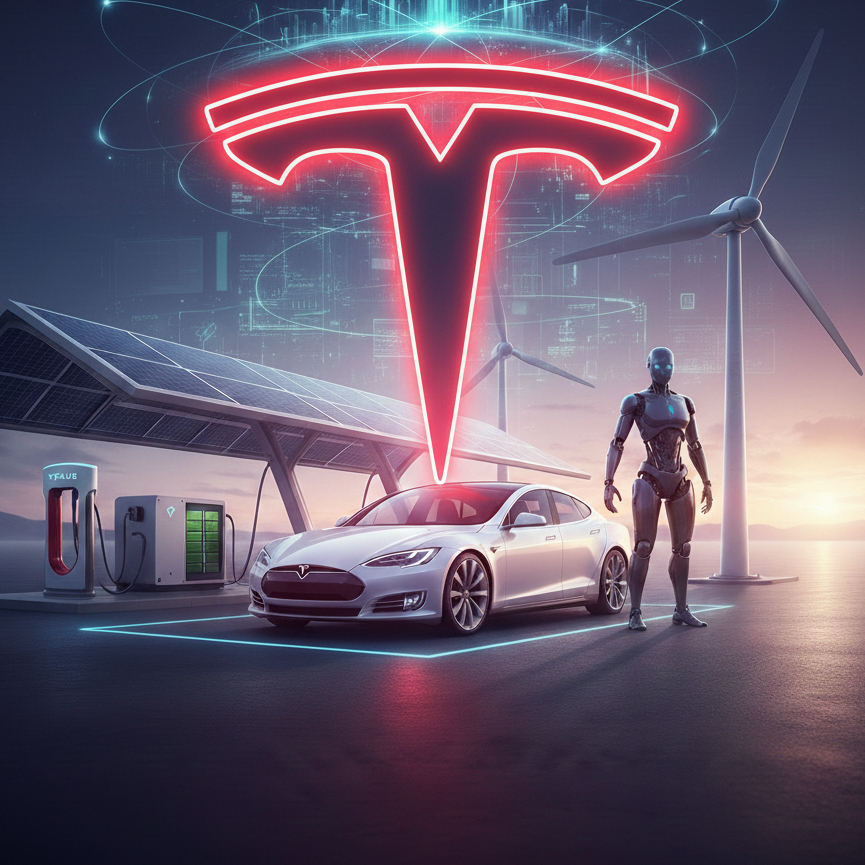
For over a decade, the primary debate surrounding Tesla was centered on vehicle delivery targets and the grueling “production hell” of its assembly lines. In early 2026, that conversation has become largely obsolete. Tesla has successfully executed a historic transition, moving from its origins as a disruptive “car company” to its current status as a highly diversified technology, robotics, and energy conglomerate. Today, the stock price no longer fluctuates primarily based on quarterly Model 3 sales figures; instead, it is driven by the scaling of its neural networks, the maturity of its autonomous software, and its pivotal role in the global energy transition.
The AI Transformation: Data as the New Structural Moat
Tesla’s valuation in 2026 is fundamentally an AI play, underpinned by a massive and growing physical footprint. While legacy automakers continue to struggle with basic software integration and over-the-air updates, Tesla’s fleet has achieved a critical milestone: surpassing 8.4 billion cumulative miles driven on Full Self-Driving (FSD) Supervised. This is not merely a technical achievement; it represents an insurmountable data moat. In the competitive landscape of Artificial Intelligence, the ultimate winner is the entity with the highest quality and volume of real-world training data.
The ability to collect and process millions of “edge cases”—those rare and complex driving scenarios—from a global fleet of millions of vehicles gives Tesla a structural advantage that software-only firms cannot replicate in simulations. This feedback loop is accelerated by the Dojo supercomputer, which, after a brief hiatus in 2025, was restarted in early 2026 with a focus on specialized AI5 silicon. For the modern investor, Tesla is a bet on the “marginal cost of autonomy.” We are approaching the inflection point where software-driven revenue, with its software-like margins, begins to fundamentally outpace the cyclical and capital-intensive margins of hardware manufacturing.
Tesla Energy: The Sleeping Giant Becomes a Global Utility
While electric vehicles often capture the media spotlight, the Tesla Energy division is rapidly becoming a critical pillar of the company’s total revenue and profit. As of early 2026, energy storage deployments—specifically the Megapack for utility-scale projects and the Powerwall 3 for residential use—have seen a staggering 49% year-over-year growth, reaching nearly 47 GWh of annual installed capacity. Tesla is no longer just a battery vendor; it is architecting a distributed, global utility network.
By aggregating thousands of residential batteries into Virtual Power Plants (VPPs), Tesla is providing essential stabilization services to aging and overstressed power grids in markets like Texas, Australia, and parts of Europe. This recurring, service-based revenue model is far more attractive to institutional investors than the traditional, low-margin automotive business. In fact, in the first quarter of 2026, the energy storage segment maintained a gross profit margin of over 30%, significantly outperforming the automotive segment which has faced margin compression due to intense global competition from manufacturers like BYD.
The Valuation Paradox: Pricing in Infinite Optionality
One of the most frequent questions from investors is why Tesla continues to trade at a Price-to-Earnings (P/E) multiple that dwarfs rivals like Toyota or Volkswagen. The answer lies in the concept of Optionality. Legacy automakers are valued based on predictable unit sales and manufacturing efficiency, resulting in low, single-digit multiples. Tesla, however, is valued as a venture capital portfolio contained within a single ticker symbol. The market is not just pricing in cars; it is pricing in the “Option” that Tesla wins the global robotaxi race.
Furthermore, the recent strategic pivot at the Fremont factory—where production of the legacy Model S and Model X is being phased out to make room for the Optimus Gen 3 humanoid robot—highlights the company’s aggressive focus on the future of labor. With a target production capacity of 1 million Optimus units annually, Tesla is positioning itself to disrupt the global industrial and domestic labor markets. When you buy TSLA in 2026, you are betting on the success of these high-stakes technological bets, essentially holding a stake in the infrastructure of the coming autonomous economy.
The Musk Premium and Strategic ETF Concentration
Despite its evolution, Tesla remains one of the most volatile and concentrated holdings in the modern financial ecosystem. It continues to be a top-5 component in the S&P 500 and the Nasdaq-100, acting as a massive driver of overall market sentiment. Because of its weight in Clean Energy and ESG ETFs, Tesla is a primary recipient of passive capital flows. This creates a high Beta Volatility, where the stock often moves with a magnitude 1.5x to 2x higher than the broader market in response to shifts in federal interest rate policy or global liquidity.
This concentration also brings the “Musk Premium” into sharp focus. Investors must weigh the visionary leadership that has successfully scaled multiple industries against the potential for distraction or controversy. In 2026, the risk for Tesla is no longer a failure to manufacture vehicles—that has been solved—but rather a potential delay in the regulatory approval of unsupervised autonomy or a slower-than-expected commercialization of the robotics division. These “narrative” shifts are what now dictate the multibillion-dollar swings in Tesla’s market capitalization.
Strategy for 2026: Balancing Long-Term Vision with Market Reality
Investors today are largely divided into two distinct camps. The Fundamentalists focus on the immediate pressures of the automotive market, such as the price-cutting competition in China and the stabilization of EV adoption rates. They see a company whose automotive margins are beginning to resemble those of a traditional manufacturer. On the other side, the Visionaries focus on the “AI Day” milestones and the geometric growth of the energy business. They view the car business as merely the “hardware substrate” for the most valuable software network in history.
is a reminder that in an inflationary world, owning the means of production—especially automated ones—is the ultimate hedge. As labor costs rise globally, Tesla’s bet on Optimus and FSD becomes increasingly relevant. The strategy for the 2026 investor must be one of calculated exposure, recognizing that Tesla is no longer just a car company, but a bet on the very future of how energy is managed and how intelligence is deployed in the physical world.
Finanlytic Takeaway
Tesla remains the ultimate narrative stock of our generation. It bridges the gap between a massive industrial manufacturer and a cutting-edge software laboratory. In 2026, the greatest risk isn’t just about selling fewer vehicles; it is about the potential for a “gap in time” between the decline of the traditional EV boom and the full commercial realization of the autonomous future. Whether Tesla is considered overvalued depends entirely on which part of its massive ecosystem you believe will dominate the next decade. At Finanlytic, we believe that understanding Tesla’s transition into an energy and AI powerhouse is essential for any modern portfolio.