
Disclaimer: The content on Finanlytic is for informational and educational purposes only and does not constitute financial, investment, or career advice. Always consult a qualified professional before making decisions based on this information.
For decades, the path to financial literacy was a slow and often tedious theoretical climb. Students would read about “compound interest” in a dry textbook, perhaps participate in a simplified “stock market game” for a single semester, and then be thrust into the real world with virtually zero practical experience. In 2026, that paradigm has been completely disrupted. Artificial Intelligence is no longer just a high-end tool for professional quantitative analysts; it has become the ultimate democratizer of financial wisdom. Today’s generation of students is utilizing AI to build a direct bridge between classroom theory and the brutal, high-speed reality of global markets.
The Hyper-Personalized AI Tutor: Bridging the Conceptual Gap
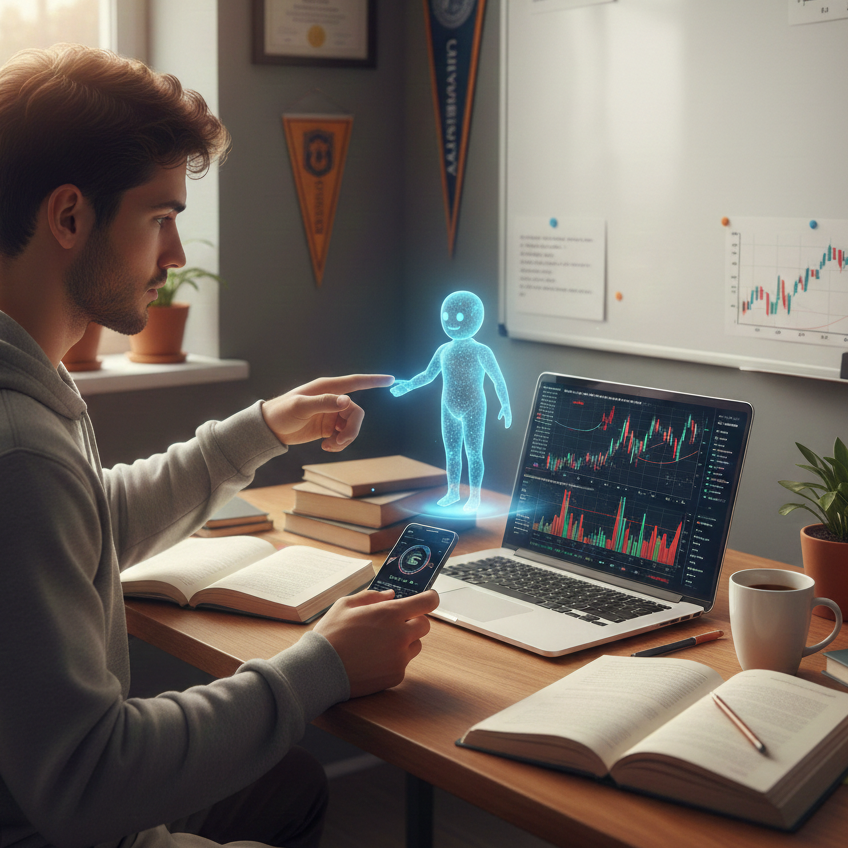
The greatest failure of traditional financial education has always been its “one-size-fits-all” approach. In a standard classroom, not every student inherently understands the inverse relationship between interest rates and bond prices on the first attempt. However, the AI-driven educational platforms of 2026 utilize Adaptive Learning Algorithms to solve this problem at scale. These systems do not just repeat definitions; they analyze a student’s specific interests and cognitive patterns to construct personalized analogies.
If a student struggles with the mechanics of “short selling,” the AI might pivot to explain the concept through the lens of a limited-edition sneaker release or a gaming marketplace. This contextual learning ensures that the core pillars of investing—risk, reward, and liquidity—are deeply internalized rather than just memorized for an exam. By meeting the student in their own world, AI is ensuring that no learner is left behind by the complexity of modern finance.
High-Fidelity Simulations: Risk-Free “Battle Testing” in a Virtual Market
Investing is an inherently emotional discipline. You cannot learn the psychological resilience required for “diamond hands” or the discipline to stay calm during a sudden 10% market correction from a book. You have to experience the pressure. The 2026 generation of AI Portfolio Simulators goes far beyond traditional “paper trading.” These advanced systems are now integrated with Generative Market Sentiment and real-time news feeds.
The AI can inject “black swan” event simulations—such as a sudden geopolitical shift or a localized energy crisis—to observe how a student reacts under stress. More importantly, these simulators utilize Neural Feedback Loops to identify behavioral biases. If a student consistently demonstrates a tendency to “average down” on losing positions, the AI mentor intervenes with an interactive lesson on the Sunk Cost Fallacy. This “sandbox” environment allows a 20-year-old to experience a decade’s worth of market cycles and emotional volatility before they ever place their first real-world trade.
Leveling the Information Playing Field with Financial LLMs
Historically, institutional investors held a massive “information advantage” because they could afford a small army of analysts to read through thousands of 10-K filings and earnings call transcripts. Students in 2026 are using specialized Financial Large Language Models (LLMs) to level this playing field. Instead of spending hours attempting to decipher a complex balance sheet, a student can now leverage tools like Claude 4.6 or specialized Excel add-ins like Shortcut to automate the “grunt work” of data extraction.
This allows the student to ask sophisticated questions: “Compare the debt-to-equity ratios of these five EV companies and highlight which one is most vulnerable to a projected interest rate hike in Q3.” By using AI to handle the manual collection of data, students can spend 90% of their time on what actually matters: Strategic Decision-Making. They are moving from being data processors to being strategic thinkers, which is exactly what the modern job market demands.
Ethical AI and the Challenge of the “Black Box”
A critical component of mastering investment in 2026 is learning the inherent limitations of the tools themselves. Top-tier financial programs now include mandatory modules on AI Ethics and Algorithmic Bias. Students are being taught that if they rely 100% on a robo-advisor without understanding the underlying logic, they aren’t truly investors—they are merely spectators.
The goal is to master Human-AI Collaboration, where the human provides the ethical judgment and long-term vision while the AI provides the computational power and pattern recognition. Learning to question an AI’s output, especially during periods of market irrationality, has become the new gold standard for career readiness in finance. Understanding the “Black Box” problem is now as important as understanding the P/E ratio.
The Impact on Gen Alpha: From Graduation to Accelerated Wealth
As the first “AI-native” generation begins to enter the workforce, we are witnessing a significant shift in wealth accumulation patterns. Students who graduate with these skills exhibit significantly lower financial anxiety because the markets are no longer a mystery to them. They have a higher awareness of risk and, most importantly, they understand the mathematical power of the Compound Interest Advantage.
By starting their investment journeys at 18 with AI-guided portfolios instead of waiting until 28, the mathematical advantage of an extra decade is life-changing. As we noted in our analysis of Ethereum’s path to $5,000, the market is becoming increasingly institutionalized and technical. Those who have been “battle-tested” in AI simulations will be the ones best positioned to navigate these volatile waters.
Finanlytic Takeaway
The classroom of 2026 has become a high-tech launchpad. AI is not a “cheat code” for the stock market; it is a high-performance training suit that amplifies human capability. For the modern student, mastering the intersection of finance and technology is no longer an elective—it is a survival skill. Those who learn to harness AI for financial literacy today will not just be participants in the global economy; they will be the ones defining it for the next generation.