

Financial Disclaimer: The insights provided on Finanlytic are for informational and educational purposes only. Content authored by Hugo Cutillas or any contributors does not constitute professional investment, financial, or tax advice. While we strive for accuracy in our macroeconomic analysis, Finanlytic is not a registered financial advisor. Always perform your own due diligence or consult a certified professional before making financial decisions.
Financial freedom is rarely the result of a lucky lottery win or a sudden inheritance; it is the product of strategy, discipline, and a deep understanding of how capital works. In the modern economy of 2026, one of the most accessible and powerful tools to achieve this independence is the stock market. Investing in stocks and Exchange-Traded Funds (ETFs) allows your capital to grow exponentially, harnessing the dual engines of compound interest and market momentum in ways that traditional savings accounts—often eroded by inflation—simply cannot match. The journey toward independence begins the moment you stop working for money and start making your money work for you through productive, liquid assets.
The journey toward independence begins the moment you stop working for money and start making your money work for you.
The Mechanics of Wealth and Capital Building
When you buy a stock, you aren’t just betting on a ticker symbol; you are acquiring a piece of a living, breathing business. Over time, ownership in productive companies compounds. As these businesses expand their operations, innovate, and capture new markets, their intrinsic value rises, which is ultimately reflected in the stock price. The primary mechanisms for wealth creation in the market include capital appreciation, which is the direct increase in the market price of your shares, and dividends, which represent a portion of the company’s profits paid out to shareholders.
Perhaps the most magical element of this process is compound growth, where your returns generate their own returns, creating a snowball effect that accelerates wealth over long horizons. This is not a linear path but a geometric one; the longer you stay in the game, the faster the wealth accumulates. For the strategic investor, the goal is to build a critical mass of capital where the annual growth of the portfolio eventually exceeds their yearly cost of living.
Capital Appreciation:
The increase in the market price of your shares as the business grows.
Dividend Yield:
he passive cash flow distributed from profits, allowing for continuous reinvestment
ETFs as the Foundation of Modern Diversification
For many aspiring investors, the idea of picking individual stocks feels overwhelming and inherently risky. This is where ETFs have revolutionized the path to freedom. These funds allow you to buy a basket of hundreds or even thousands of stocks in a single transaction, providing instant diversification, which is often called the only free lunch in finance. By spreading your capital across various sectors and geographies, you drastically reduce the risk of a single company’s failure ruining your entire portfolio.
For a strategy aimed at financial independence, low-cost index ETFs serve as a reliable and efficient foundation. These instruments allow you to capture the growth of the entire global economy rather than trying to find a needle in a haystack. By holding a broad-market ETF, you are essentially betting on human ingenuity and the continued expansion of global commerce, which has proven to be a winning bet over any significant historical timeframe.
Consistency Over the Big Win
The media often glorifies the day trader who makes a fortune overnight, but true financial freedom is built on the boring, quiet discipline of consistency. This is often referred to as Dollar-Cost Averaging. By investing a fixed amount every month, regardless of whether the market is up or down, you buy more shares when prices are low and fewer when they are high. This disciplined approach removes the emotional noise of the market and ensures that you are constantly building your position in the global economy.
In parallel to this, the psychological advantage of automation cannot be overstated. When you automate your investments, you remove the temptation to time the market or skip a month due to temporary financial fears. Over decades, this habit creates a massive cumulative advantage that far outweighs the results of those trying to hunt for the next “hot stock.” Consistency is the bridge between a dream of independence and the mathematical reality of wealth.
Time in the Market versus Timing the Market
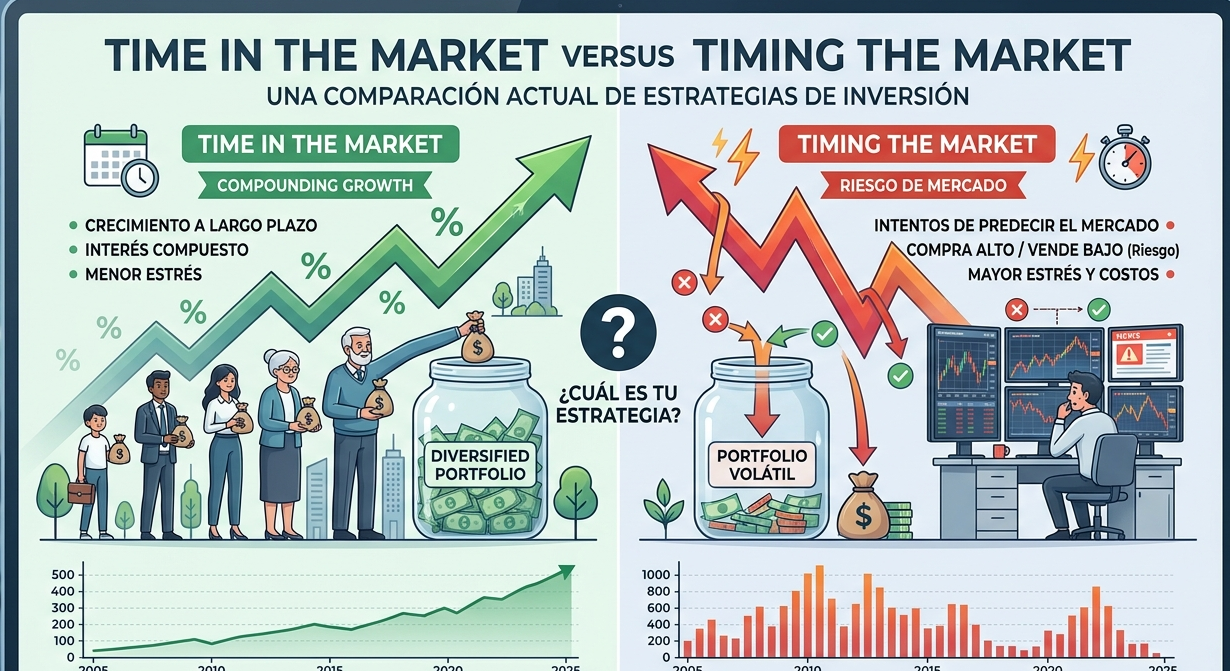
A common trap for beginners is trying to time the market by waiting for the perfect crash to buy or the perfect peak to sell. Historical data consistently proves that time in the market is far more important than timing the market. Missing just the ten best trading days in a decade can cut your total returns nearly in half, as those days often occur during periods of extreme volatility.
Long-term investors recognize that market volatility is simply the fee you pay for long-term returns. By staying invested through the dips, you capture the full recovery and the subsequent growth that follows. The goal is to maximize the duration of your investment, allowing the mathematical power of compounding to do the heavy lifting while you focus on your career and life goals.
The Dividend Engine and Passive Cash Flow
Dividends are the silent heroes of financial independence. When you reinvest dividends, you are buying more shares, which in turn produce even more dividends in a self-reinforcing cycle. Over a twenty or thirty-year period, reinvested dividends can account for a massive percentage of a portfolio’s total value. For those nearing their goal of freedom, dividend-paying stocks and specialized Dividend ETFs can provide a consistent cash flow that covers living expenses without ever needing to sell the underlying shares.
This creates a state of perpetual wealth where the principal remains untouched while the income generated sustains your lifestyle. This is the ultimate definition of making your money work for you. Furthermore, as companies grow their dividends over time, your “yield on cost” increases, often providing an income stream that far outpaces inflation and maintains your purchasing power in any economic environment.
The ETF Shield and Global Risk Management
While individual stocks offer high potential, they also carry idiosyncratic risk—the risk that a single CEO’s mistake or a specific industry shift could destroy a company. An ETF manages this through broad exposure across multiple industries such as technology, healthcare, and energy. Additionally, many modern ETFs offer global reach, accessing international markets to hedge against a downturn in a single country’s economy.
These funds also utilize automatic rebalancing, ensuring the fund always holds the most relevant and successful companies while rotating out of those that are failing. This “survival of the fittest” mechanism is built directly into the index, meaning your portfolio is constantly evolving to match the current market leaders without you having to lift a finger. This structural safety is what makes ETFs the preferred vehicle for long-term wealth preservation.
Psychology and the Financial Frontier

Ultimately, the market is a device for transferring money from the impatient to the patient. To achieve financial independence, an investor must master their own psychology and avoid the trap of emotional trading. This means resisting the urge to sell in a panic when the news cycle turns negative or the market experiences a temporary correction.
Success requires focusing on the ten-year horizon rather than the ten-minute chart. Wealth is a marathon, not a sprint, and those who embrace patience are the ones who ultimately win the prize of freedom. Mastering your mindset is just as important as mastering your portfolio allocation; without the emotional fortitude to stay the course, the best strategy in the world will fail.
Getting Started on the Path to Freedom
To begin this journey, you must first define your freedom number, which is the total amount of passive income you need to sustain your life. Once that target is set, the next step is to automate your future by setting up recurring contributions to a brokerage account. It is vital to start as early as possible because every year you wait costs you exponentially more in the future due to the loss of compounding time.
Stay curious about market flows and signals, but keep your core strategy simple and focused on low-cost, high-quality assets. Financial freedom is not a distant dream but a mathematical reality for those who start today and remain disciplined through the years. The stock market is the most efficient wealth-creation machine ever invented, and by utilizing stocks and ETFs, you are building a bridge to a life where you finally own your time.
Finanlytic Takeaway

FINANLYTIC | DATA INTELLIGENCE UNIT | Analysis by Hugo | Lead Market Strategist
Financial freedom is a choice made through daily discipline and long-term vision. By shifting your perspective from consumer to owner, you unlock the ability to build a legacy that lasts. The market doesn’t care about your background; it only rewards your persistence and your ability to remain invested when others are running for the exits. At Finanlytic, we believe that the tools for independence are within everyone’s reach—the only requirement is the courage to begin and the patience to let the process unfold.