
Financial Disclaimer: The insights provided on Finanlytic are for informational and educational purposes only. Content authored by Hugo Cutillas or any contributors does not constitute professional investment, financial, or tax advice. While we strive for accuracy in our macroeconomic analysis, Finanlytic is not a registered financial advisor. Always perform your own due diligence or consult a certified professional before making financial decisions.
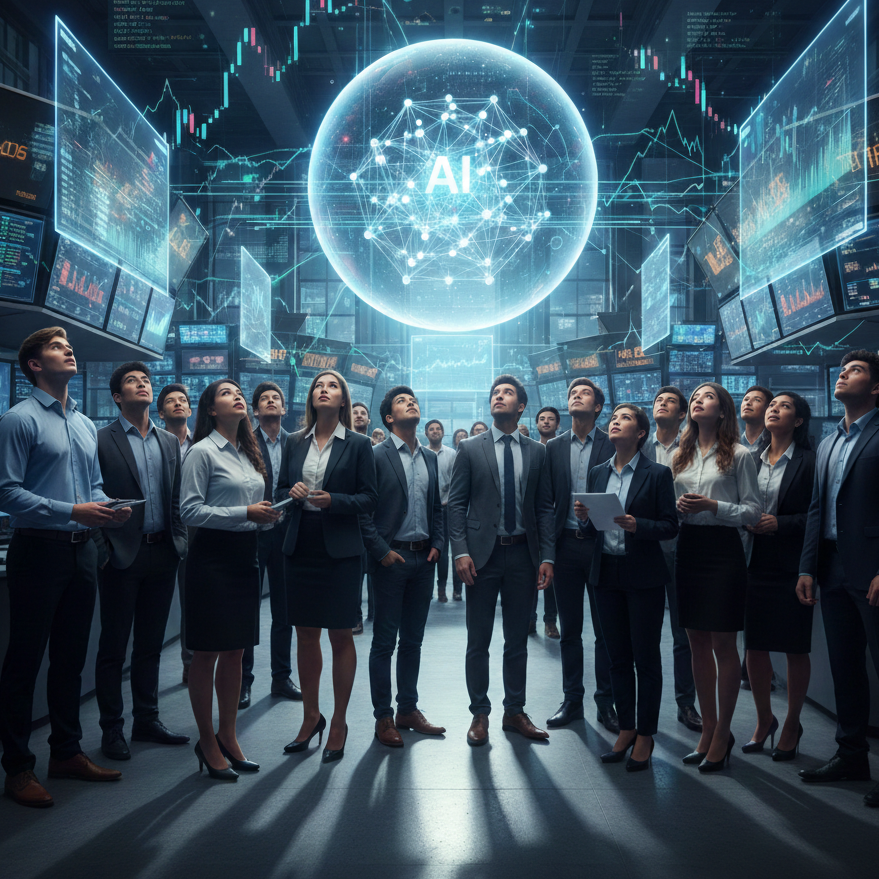
The global financial market is currently changing at a pace that is fundamentally outpacing human comprehension. While retail investors and traditional analysts are still squabbling over macroeconomic predictions and narrative-driven stories, a significant portion of actual market movements—specifically timing, order sizing, and execution speed—is now being orchestrated by artificial intelligence. This transformation was not an overnight revolution; it arrived subtly, driven by the sheer necessity of the environment. As markets morphed into hyper-complex ecosystems awash in petabytes of data, they simply exceeded the biological limitations of human traders. AI did not substitute human choice in its entirety; rather, it absorbed all the operational portions that humans were no longer equipped to handle.
Speed Broke the Old Model of Trading
Financial markets in 2026 function at breakneck speeds that render manual trading nearly obsolete in certain sectors. Prices shift within mere milliseconds, and liquidity—the lifeblood of any trade—materializes and vanishes in the blink of an eye. In this environment, news does not travel in the traditional sense; it teleports across the globe via high-speed fiber and satellite links. Human response times, which are measured in hundreds of milliseconds, simply cannot compete with the near-instantaneous reaction of a machine.
By the time a human trader can process a headline, interpret its meaning, and move their hand to execute a trade, the market opportunity has likely already been captured and closed by an algorithm. Artificial intelligence stepped into this gap, transforming complex analysis into immediate action. This shift is a direct result of the fact that, where the friction of time has been almost entirely removed from the capital allocation process.
Data Overload as the Catalyst for Automation
The modern market produces an exhausting amount of data every second. For a human, this is a chaotic wall of noise that leads to analysis paralysis. For a machine learning model, however, it is a structured dataset to be refined and exploited. AI excels at singling out the signal while discarding the noise, ensuring that trade implementation is based on statistical probability rather than emotional guesswork.
Consider the sheer volume of variables an AI processes simultaneously without ever experiencing fatigue. It monitors thousands of bid and ask changes per second across multiple exchanges while tracking real-time shifts in the VIX and the implied volatility of options. Simultaneously, it parses central bank statements and economic reports while performing sentiment analysis on global news feeds. This multidimensional approach allows the machine to build a world view that is far more comprehensive than any human analyst could achieve in a lifetime of study.
Execution is Where AI Dominates the Game
While many believe the primary role of AI is predicting the future, its most significant strength actually resides in execution. Success in professional trading relies on much more than just being right about a price move; it depends on entry and exit timings, appropriate position sizing, and, crucially, minimizing market impact. If a large institution tries to buy a massive block of shares at once, they will inadvertently drive the price up against themselves, eating into their own potential profits.
AI execution algorithms solve this problem by breaking orders into thousands of tiny pieces and adapting in real-time to available liquidity. They stealth into positions, optimizing every cent to ensure the best possible average price. While humans still oversee the overarching strategy and the long-term vision, machines handle the heavy lifting of making that vision a reality with surgical efficiency. This level of precision has turned trading from an art into a high-stakes engineering challenge.
Risk Management at Machine Speed
In the modern era, risk management cannot wait for a daily summary or a weekly meeting. Risk has become dynamic and fluid. AI systems are constantly monitoring exposure, cross-asset correlations, and tail risks—those rare but devastating events that can wipe out a portfolio in minutes. When market circumstances change, AI-driven positions shift automatically without the need for human intervention.
These systems can cap losses and tighten stop-losses before human emotions such as hope or denial can interfere with the decision-making process. This is a primary reason why major institutional players lean so heavily on AI: it ensures a level of cold, mathematical discipline that is impossible for a human to maintain during a crisis. By removing the ego from risk management, AI acts as a vital safety net for the global financial system.
DATA INTELLIGENCE UNIT
| Risk Parameter | Manual Control | AI-Driven Protocols |
|---|---|---|
| Stop-Loss Lag | High (Human Delay) | Zero (Automated) |
| Asset Correlations | Occasional Checks | Real-time (24/7) |
| Emotional Bias | High (Hope/Denial) | Zero (Mathematical) |
| Crisis Management | Reactive | Proactive / Predictive |
The Interconnected Web of Global Capital
Markets today are more interconnected than at any point in history. A shift in Japanese bond yields can trigger a sell-off in U.S. tech stocks, which in turn affects the liquidity of major cryptocurrencies. These relationships are in a state of constant flux and are often invisible to those looking at only one sector. AI is uniquely capable of spotting these cross-market whispers because it does not see markets as isolated silos; it observes them as a singular, complex system.
When a whisper of risk appears in the foreign exchange market, an AI can hedge a stock portfolio in milliseconds. It reacts to the system’s internal friction before the average investor even realizes something is wrong. This holistic view of global capital is what allows algorithmic systems to maintain an edge in an environment where everything affects everything else.
Why Humans Still Provide the North Star
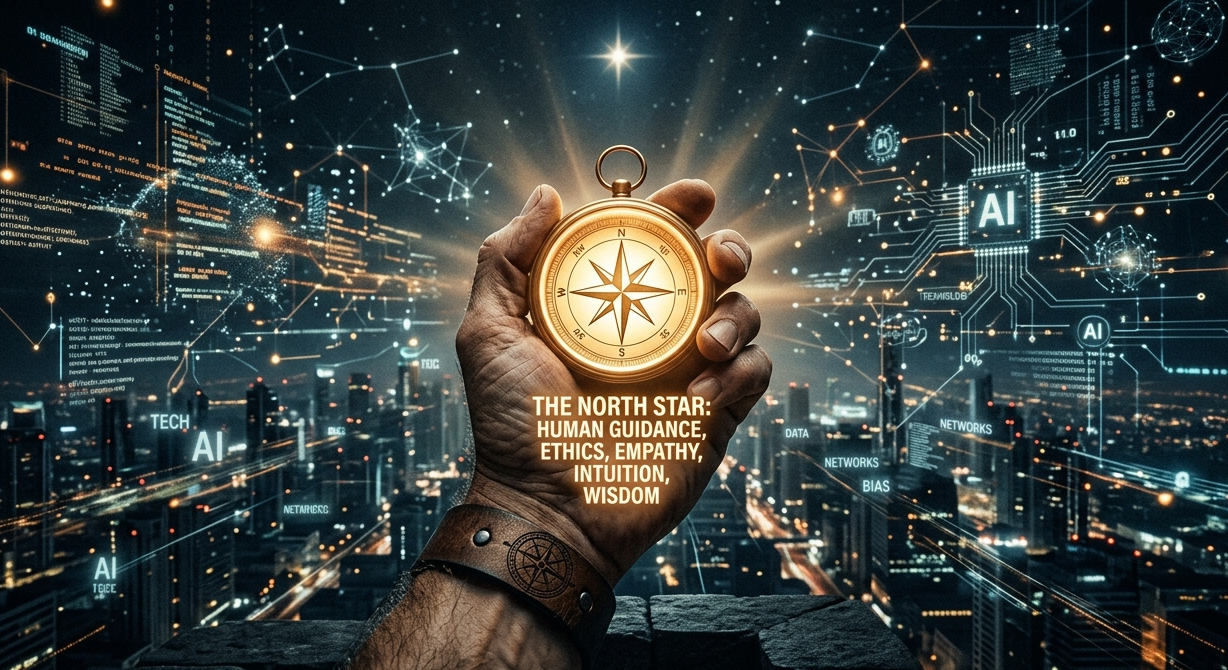
Despite the dominance of machines in the technical realm, humans remain the essential architects of the financial world. AI does the technical work, but people still decide the objectives. Humans are the ones who define the ultimate goals, set the acceptable risk parameters, and outline the ethical boundaries of a fund. The AI does not know why it is trading; it only knows how to achieve the target it was given as efficiently as possible.
In 2026, the financial sector is not a contest between humans and robots. Instead, it is a sophisticated partnership where human will is executed through the precision of machines. The AI does not replace good sense or strategic intuition; it simply allows that sense to be practiced on a global scale with zero latency. The human provides the direction, and the machine provides the power.
AI as the New Basic Infrastructure
For firms today, AI execution is no longer a competitive advantage; it is basic infrastructure. Relying exclusively on human manual execution in a high-frequency world is like trying to win a Formula 1 race on a bicycle. Liquidity, pricing, and even the nature of volatility itself now reflect the constant presence of algorithms.
If an investor ignores this reality, they will inevitably misinterpret market signals and make terribly mistimed choices. The market no longer asks if AI is present; it simply assumes it is the baseline for all activity. This normalization of artificial intelligence means that the “alpha” or the extra profit now comes from how well a human can direct these autonomous systems, rather than the ability to execute a trade manually.
Finanlytic Takeaway
FINANLYTIC | DATA INTELLIGENCE UNIT | Analysis by Hugo | Lead Market Strategist
Artificial intelligence manages the majority of market choices today because the environment demands a level of rapidity, exactness, and discipline that humans simply cannot provide. The true question for the modern investor is not whether AI should be making these choices, but how effectively your own strategy integrates with this machine-led reality.
At Finanlytic, we focus on the intersection of human strategy and machine execution. Success in 2026 requires more than just a good idea; it requires a system that can translate that idea into action before the opportunity vanishes. The future belongs to those who embrace the algorithmic sovereignty of the modern market and learn to lead the machines that now run the world of finance.