
Financial Disclaimer: The insights provided on Finanlytic are for informational and educational purposes only. Content authored by Hugo Cutillas or any contributors does not constitute professional investment, financial, or tax advice. While we strive for accuracy in our macroeconomic analysis, Finanlytic is not a registered financial advisor. Always perform your own due diligence or consult a certified professional before making financial decisions.
Artificial intelligence is no longer a futuristic concept whispered about in Silicon Valley laboratories; it is the primary engine behind today’s financial markets. From high-stakes investment decisions to granular risk management, fraud detection, and complex trading strategies, AI algorithms are quietly running the systems that dictate the movement of billions of dollars every single day. This is not mere marketing hype. AI isn’t waiting for a slow wave of adoption; it has already successfully transformed the way money moves, settles, and grows in a digital-first economy.
DATA INTELLIGENCE UNIT
| Feature | Human-Led Finance | AI-Driven Finance |
|---|---|---|
| Processing Speed | Hours / Days | Milliseconds |
| Availability | Market Hours | 24/ 7 / 365 |
| Data Capacity | Limited Samples | Massive Unstructured Data |
| Decision Base | Intuition & Emotion | Logic & Algorithms |
| Error Margin | High (Fatigue/Bias) | High (Fatigue/Bias) |
The Invisible Hands of Modern Finance
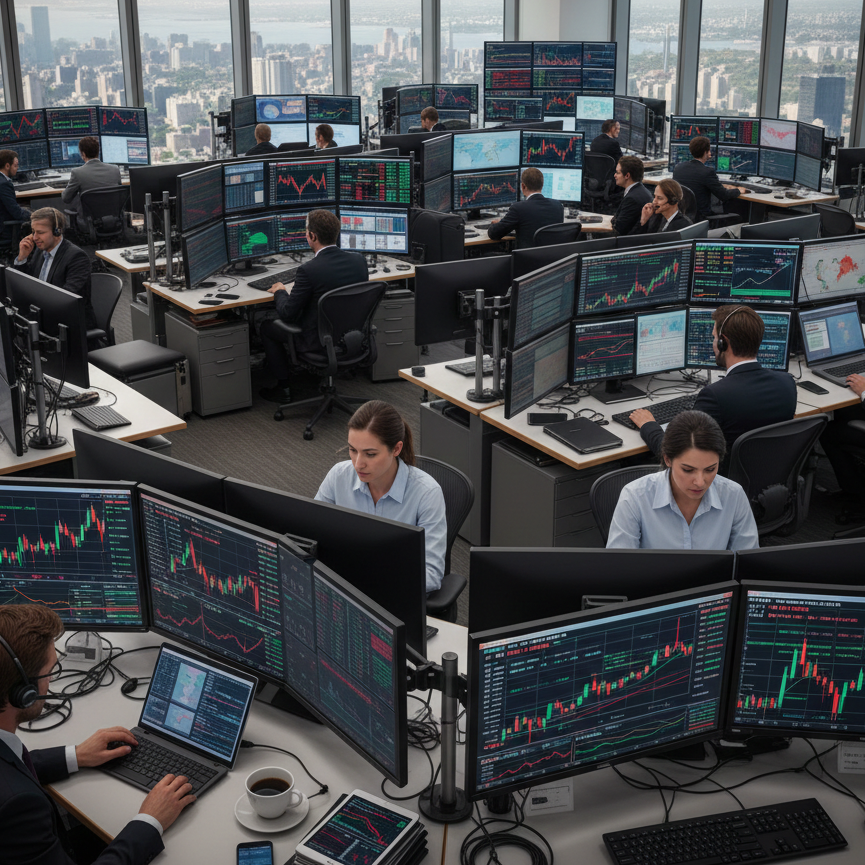
Traditionally, financial markets were the ultimate theater of human psychology. They relied on human intuition, historical patterns, and slow-moving manual analysis. A trader’s gut feeling was once a celebrated asset. Today, that gut feeling has been replaced by cold, hard processing power. Modern AI systems process vast streams of unstructured data in milliseconds, detecting trends, correlations, and anomalies that a human analyst could never hope to see, let alone interpret in time.
Every trade, every risk assessment, and every portfolio tilt is influenced by algorithms that never sleep, never tire, and never fall prey to the emotional biases of fear or greed. In essence, AI has become the invisible hand guiding global finance, acting long before human eyes even notice the signals. This shift has permanently moved the goalposts for what we consider “market intelligence,” prioritizing computational speed over traditional academic theory.
From Data Overload to Actionable Insight
We live in an age of data obesity. Financial markets produce millions of data points per second, including fluctuating stock prices, bond yields, complex derivatives, and shifting macroeconomic indicators. To a human, this is noise. For an AI, it is a map. AI turns this overwhelming noise into clear, actionable insights by analyzing patterns across multiple asset classes, timeframes, and geographies simultaneously.
This gives institutional players a decisive edge over those still relying on traditional methods. Consider high-frequency trading where AI can detect a subtle trend in milliseconds, predicting a volatility spike before the broader market even flinches. It spots arbitrage opportunities across global exchanges that exist only for a fraction of a second. In every case, AI transforms raw, messy data into surgical decisions that define the modern landscape. Understanding this dominance is crucial because, as the industry standard now dictates, is a matter of mathematical necessity rather than choice.
Risk Management in the AI Era
In 2026, risk is no longer managed by spreadsheets and experience alone. The margin for error has shrunk to near zero, requiring a level of oversight that only autonomous systems can provide. AI systems can now simulate thousands of hypothetical market scenarios in seconds, stress-testing massive portfolios against black swan events that haven’t even happened yet.
This predictive power means institutions can anticipate market shocks and adjust their positions before a local crisis spreads into a global contagion. By removing the human factor, firms reduce the risk of emotional panic-selling or irrational exuberance. AI doesn’t just measure the risk you have; it predicts the risk that is coming, acting as a structural shield for the world’s most complex capital pools.
Fraud Detection as the Financial Immune System
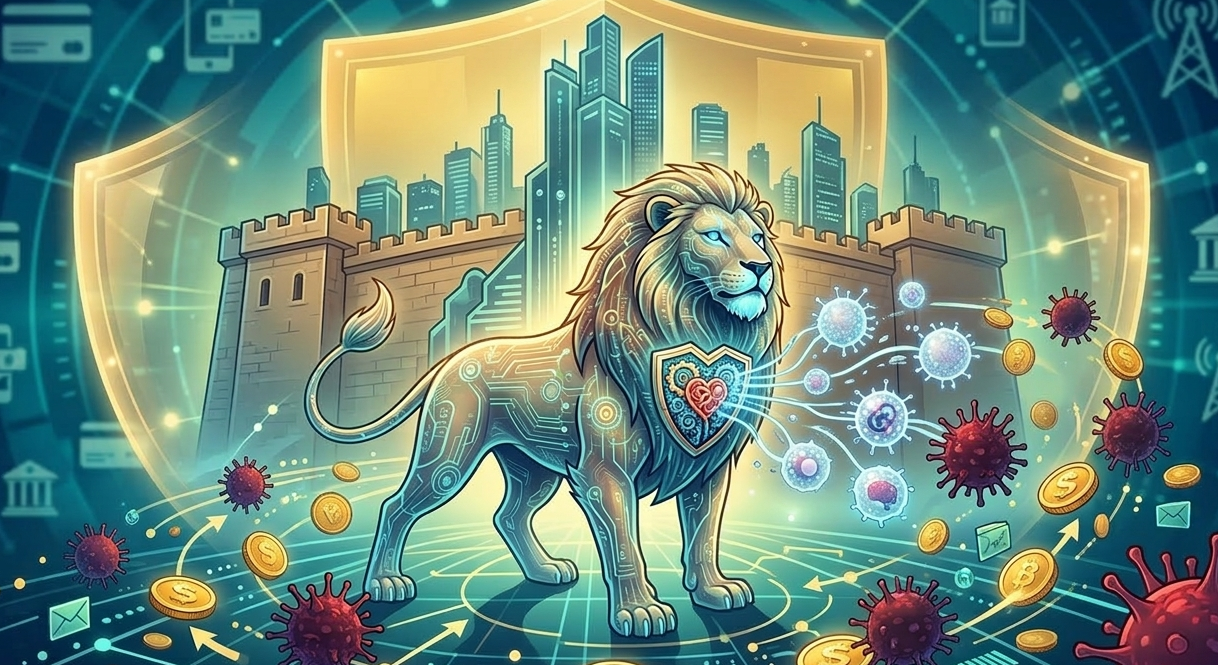
AI isn’t just about aggressive profit-seeking; it’s also the primary protector of the financial system. With billions of transactions occurring daily, traditional human monitoring is physically impossible. AI models act as a digital immune system, detecting unusual patterns, flagging suspicious activity, and preventing multi-million dollar frauds in real-time.
These same systems help banks navigate the labyrinth of global regulations, automatically monitoring compliance and highlighting red flags before they escalate into legal disasters. This proactive protection ensures that while the speed of money increases, the security protocols governing those movements evolve at the same pace, maintaining trust in a purely digital environment.
AI Pervasiveness Across All Asset Classes
The reach of artificial intelligence is pervasive, leaving no corner of the financial world untouched. In the crypto markets, AI is used to analyze social media sentiment to anticipate pump-and-dump schemes and track whale movements across the blockchain with surgical precision. When we look at fixed income, algorithms now predict the impact of interest rate shifts on bond yields with far greater accuracy than traditional models.
Furthermore, retail banking has been completely overhauled, from automated lending decisions to assessing individual credit risk. This has streamlined how the average person interacts with money. Even portfolio management has changed forever, as robo-advisors now manage billions, allocating capital with an efficiency that often outperforms human-managed funds over the long term. This broad adoption across sectors confirms that AI is not a niche tool, but a foundational requirement.
Human and Machine as the New Frontier
A common fear is that AI will replace humans entirely. In reality, AI is amplifying human ability. Traders, analysts, and managers are being freed from the grunt work of data entry and basic pattern spotting. They are now focusing on high-level strategy, ethics, and creative judgment. This partnership allows humans to operate at levels of complexity that were previously impossible, turning raw intuition into data-informed action. The synergy between human strategic thinking and machine processing speed is what creates the most successful investment firms of 2026.
Challenges and the Ethical Gap
Of course, this brave new world isn’t without its shadows. Over-reliance on black-box algorithms can lead to systemic vulnerabilities, such as flash crashes where machines trigger each other in a downward spiral. There are also deep ethical questions regarding whether a machine should decide who is worthy of credit or who is accountable when an autonomous trade causes a market disruption. Transparency and human oversight remain the only safeguards against a purely algorithmic catastrophe. Addressing these ethical gaps is the next great challenge for the financial community as we integrate more deeply with autonomous systems.
The Future Is Already Here
AI adoption is no longer a luxury or a competitive advantage; it is a mandatory requirement for survival. Firms that ignore the power of the algorithm risk falling into a permanent lag, missing opportunities that AI detects instantly. We have entered an era where financial intelligence is fundamentally artificial, and the traditional barriers between technology and finance have completely dissolved.
Finanlytic Takeaway
FINANLYTIC | DATA INTELLIGENCE UNIT | Analysis by Hugo | Lead Market Strategist
Artificial intelligence is the present-day operating system of the financial world. Every trade, every risk calculation, and every market signal you see is already influenced by smart algorithms. For the modern investor, the choice is simple: learn to navigate the AI-driven landscape, or be outpaced by machines that never sleep. The edge belongs to those who embrace the code and understand that in 2026, the only way to compete with the machine is to master it.