
Financial Disclaimer: The insights provided on Finanlytic are for informational and educational purposes only. Content authored by Hugo Cutillas or any contributors does not constitute professional investment, financial, or tax advice. While we strive for accuracy in our macroeconomic analysis, Finanlytic is not a registered financial advisor. Always perform your own due diligence or consult a certified professional before making financial decisions.
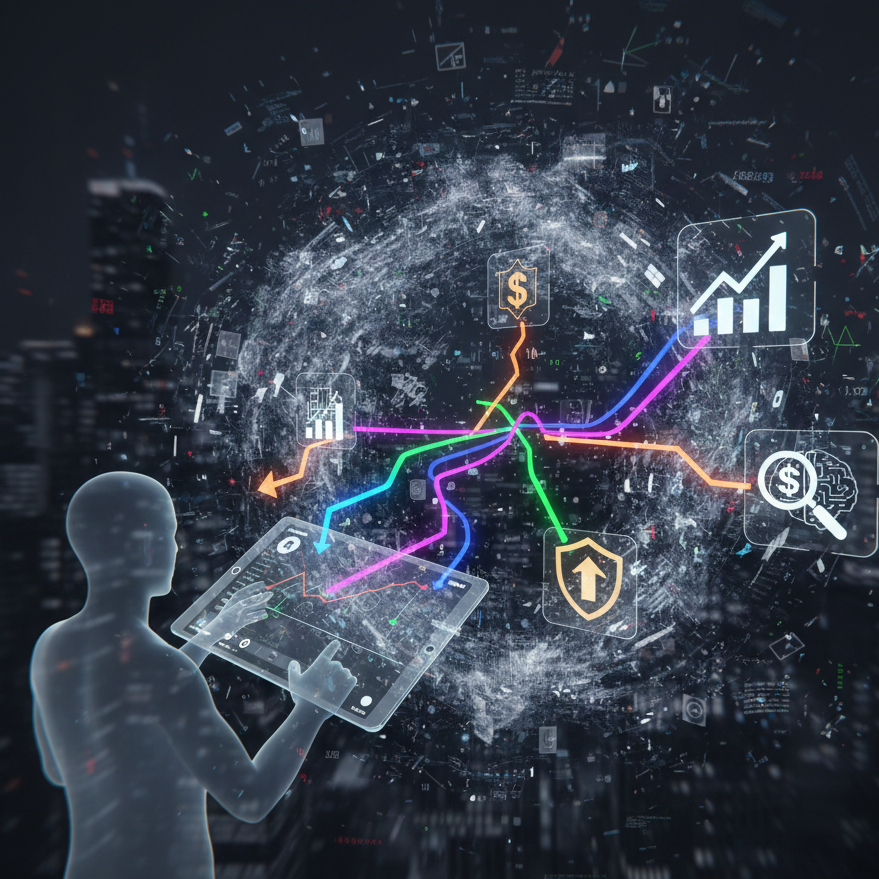
In today’s hyperconnected, high-speed financial world, information isn’t just a resource—it’s a flood. We are constantly bombarded from every angle: prices shift in milliseconds, news breaks by the second on global wires, and social media sentiment can swing multi-billion dollar markets overnight. For anyone not equipped to process this torrent, the market feels like an indecipherable mess of chaos. It is a constant, deafening noise.
The Signal Edge: 2026 Quick Insights
- Precision over Intuition: Moving from “gut feelings” to data-backed entry points.
- AI Synthesis: Algorithms now process sentiment from social media and dark pools in real-time.
- The Human Filter: Signals provide the data, but human judgment avoids “False Positives.”
But for those who have been trained to read between the lines, this noise holds the most powerful weapon in modern trading: Market Signals. These are far more than just random data points or green and red candles on a screen. They are the hidden cues, the mathematical patterns, and the behavioral triggers that reveal what is really happening beneath the surface of the price action. Think of them as the heartbeat of the financial ecosystem, pulsing invisibly, guiding the decisions of the Smart Money and creating massive opportunities for those who know how to listen closely.
The Death of Guesswork: The Shift Toward Precision
For decades, trading was a game of pure intuition. It relied heavily on gut feelings, historical experience, and the subjective interpretation of veteran floor traders. Investors would spend hours hunched over paper charts, trying to anticipate trends from patterns that were often misleading or completely invisible to the untrained eye. In that era, the loudest voice or the most experienced gut often won the day.
Today, the game has been fundamentally rewritten through the lens of data science. Market signals, when harnessed with technical precision, turn chaos into clear, actionable insights. They act as a sophisticated filter, stripping away irrelevant fluctuations and highlighting the movements that actually carry weight. This transition from subjective guessing to objective interpreting is what defines the modern professional trader.
Imagine two traders watching the exact same price chart. The first trader sees random ups and downs; they react emotionally to every tick, buying at the top out of FOMO and selling at the bottom out of fear. The second trader, using a stack of sophisticated market signals, identifies a subtle trend divergence. They see a signal that suggests a massive institutional move hours or even days before it becomes obvious to the public. The difference in their profit and loss is not luck; it is signal clarity and the ability to ignore the superficial noise that distracts the masses.
AI and Machine Learning: The Signal Revolution
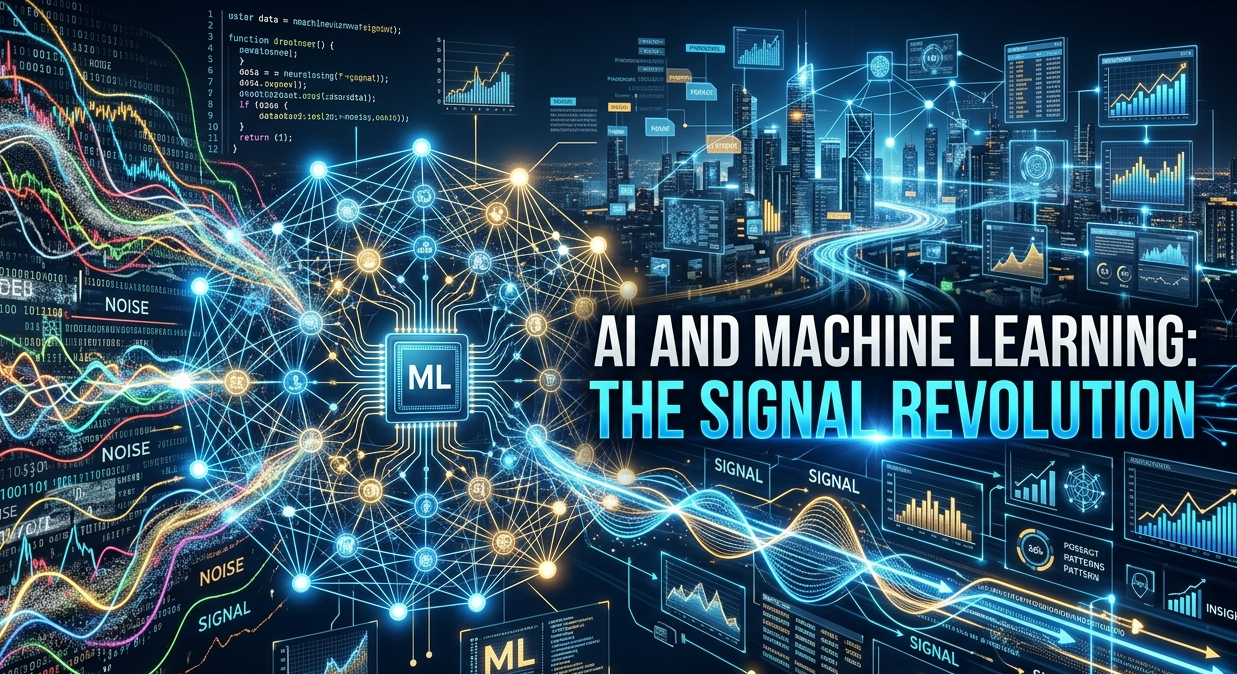
The true revolution in 2026 comes from the marriage of market signals and Artificial Intelligence. Human analysts are limited by biology; we can only process so much information before cognitive fatigue sets in. Algorithms, however, process billions of data points in seconds, including price movements, news sentiment, social media trends, and global macroeconomic indicators.
These AI systems do not just react to what happened; they predict what is likely to happen. They are constantly learning from anomalies that a human would miss. For instance, sophisticated sentiment analysis now allows for scanning millions of social media posts to detect a shift in investor mood before the price reflects it. Furthermore, anomaly detection helps in spotting unusual volume spikes in dark pools that signal institutional accumulation long before the retail market wakes up.
Another key aspect is cross-asset correlation, which involves recognizing when a move in the bond market will trigger a specific reaction in tech stocks or crypto. Finally, macroeconomic integration allows these systems to automatically adjust trade signals based on sudden changes in interest rates or inflation data. For example, a sudden spike in online discussions about a specific semiconductor company might look like noise to a human, but to an AI-driven signal processor, it is an early warning that investor sentiment is shifting. This predictive power has turned signals from reactive tools into strategic assets.
How Signals Drive Real-World Strategies

Market signals are no longer a pro-only feature; they are essential for survival at every level of the game. Institutional hedge funds and savvy retail traders alike use them to refine their edge through several key pillars of modern analysis.
Advanced Trend Detection remains the primary goal for many investors today. Identifying an emerging trend before it hits the mainstream media is the Holy Grail of investing. Catching a move in its infancy is the difference between a modest gain and a life-changing return. In addition to this, Timing and Execution are greatly improved by signals because they provide the precise moment to act. By highlighting optimal entry and exit points, these tools strip away the guesswork and significantly improve risk-adjusted returns.
Moreover, Strategic Risk Management is enhanced because signals act as a sophisticated early warning system. When a signal breaks or turns negative, it tells the trader to hedge or exit immediately, turning potential catastrophes into calculated and manageable risks. Lastly, Behavioral Insight Analysis allows investors to see how fear and greed are driving the market. AI analyzes sentiment signals to uncover when a market has overreacted, providing a powerful contrarian signal to buy when others are panicking and sell when the crowd is irrationally exuberant.
The Dopamine Hit: The Psychology of the Signal
There is a psychological element to this that is rarely discussed in financial textbooks: the dopamine moment. Correcting interpreting a market signal provides a spark of clarity that is almost addictive. It is the adrenaline of acting decisively while the rest of the market is still confused and hesitating.
In 2026, the red days are no longer scary; they are simply data points that inform your next move.
Each successful trade validated by a signal reinforces a trader’s confidence and sharpens their intuition. This psychological edge is what allows professional traders to remain calm during periods of extreme volatility. When you have a proven system of signals, the red days are no longer scary; they are simply data points that inform your next move. This mental stability is often the deciding factor in long-term wealth creation because it prevents the emotional errors that wipe out most accounts.
Challenges: The Danger of False Positives
However, we must be clear that signals are not magic wands. Misinterpretation, an over-reliance on a single indicator, or using poor-quality data can lead to expensive mistakes. This is where the human element remains vital. AI can process the data, but human insight is needed to understand the underlying reasons for market behavior.
Signals are most effective when viewed as part of a larger and holistic system. They should complement a broader strategy rather than replacing it. The key to long-term success in 2026 is learning how to filter out false positives. These are signals that look like opportunities but are actually just traps set by market volatility or manipulation. A professional trader knows that the signals they ignore are often just as important as the ones they follow. Relying on a single source of data is a recipe for disaster in a market as complex as the one we face today.
The Future is Signal-Driven
The trajectory of the global economy is undeniable as markets become more data-driven, more predictive, and much faster. Traders who choose to ignore these signals are essentially flying blind in a storm. Master the art of signal interpretation and you gain a decisive and permanent edge over the rest of the market participants.
Market signals are redefining the very landscape of the financial world. They are transforming the market from a chaotic and reactionary environment into one where patterns emerge and strategies become surgical. The noise is no longer something to be feared; it is a source of power. In the coming years, the gap between those who use signals and those who do not will only widen, creating a new financial elite defined by their ability to decode the digital pulse of the global economy.
Finanlytic Takeaway
FINANLYTIC | DATA INTELLIGENCE UNIT | Analysis by Hugo | Lead Market Strategist
In this new era, success is not about reacting to the market after it moves; it is about interpreting the signals before the move happens. From noise to insight, signals are the compass of modern trading. They turn raw data into confidence, risk into opportunity, and uncertainty into decisive action.
If you want to win in 2026, stop looking at the price and start listening to the pulse of the data. Focus on developing a system that prioritizes clarity over volume. Remember that the goal is not to trade more, but to trade better by following the signals that truly matter. At Finanlytic, we believe that the future of finance belongs to the informed, the disciplined, and those who can hear the signal through the noise of the crowd.